Every apparel category in California had to get the PFAS out by January 1, 2025. Every category except one.
Outdoor apparel for severe wet conditions got an extension. Under AB 1817 those jackets can keep containing PFAS until January 1, 2028, and in the meantime they only have to say so: a label reading "Made with PFAS chemicals," on the garment and in the online listing. New York's ban landed on the same date with the same shape. Rain gear is the last thing standing, and it is worth asking why the one category that had to be carved out is the one you wear over everything else.
How PFAS gets into a rain jacket
The answer is the finish. A rain jacket keeps water out two ways, and both of them have historically run on fluorine. There is the polyester or nylon membrane laminated inside the shell, and there is the durable water repellent sprayed on the face fabric, the DWR, the thing that makes rain bead on the shoulders of a new coat instead of soaking in. That carbon-fluorine bond is what makes a drop sit up on the surface, and it is the same bond that means the chemical does not break down in a landfill, in a river or in a person. The EPA and the CDC both now describe PFAS exposure as persistent and cumulative, and a 2024 study in Environment International found the compounds can move through human skin. The same finish shows up in gym clothes, which is a longer story about PFAS in leggings. The industry is moving off them, unevenly, and the deadline says how unevenly.
Waxed cotton is the natural fiber version
There is an older way to make cotton shed water, and it predates all of it. You put wax in the weave. Waxed cotton has been made in Dundee and Lancashire since sailcloth, it is what British Millerain and Halley Stevensons have sold to outerwear brands for a century, and it works on a completely different principle: no coating chemistry, no membrane, just a natural fiber and a wax that fills the spaces between the threads.
Water-repellent is not waterproof
It also is not a technical shell, and that difference is the whole honest version of this list. Waxed cotton is water-repellent, not waterproof. Rain beads and rolls for a good while, then eventually gets through, and there are no taped seams behind it. For a commute, a dog walk, a school run, a drizzle, it is more than enough. For a day above the treeline it is not, which is precisely the gap the exemption was written around.
The part nobody discloses: what is in the wax
One more thing worth saying plainly, because the rest of the internet will not. Wax itself is not automatically clean. The traditional recipe leans on paraffin, which is a petroleum product, and almost no brand publishes what is in the tin. The clearest exception is Patagonia, whose Lightweight Waxed Cotton Jacket states a Halley Stevensons wax called EverWax Olive that the brand describes as plant-based and paraffin-free, made using waste from the food industry. That jacket is the first pick below. None of the other nine say what is in their wax. What they all do is skip the mechanism that puts PFAS in a rain jacket in the first place, and every one of them is cotton rather than plastic underneath.
Scores below are the Toxome Score, which reads the fiber composition the brand publishes. Where a lining brings a synthetic into the picture, it is named.
The 10 best PFAS-free natural fiber rain jackets at a glance
- Patagonia Lightweight Waxed Cotton Jacket, $369, score 92. Best overall, and the only one that says its wax is paraffin-free.
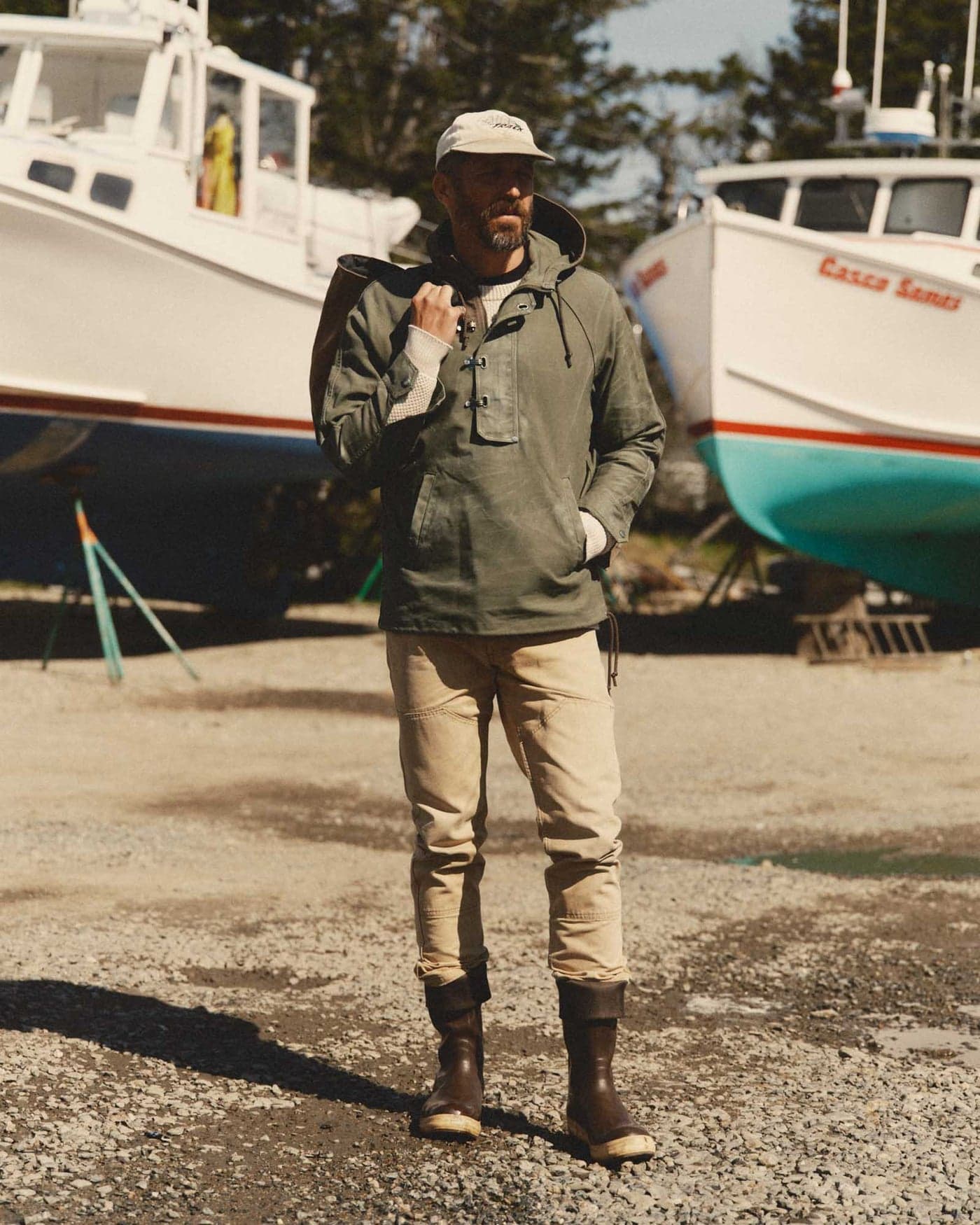
- Taylor Stitch The Hatteras Anorak, $248, score 92. Best pullover anorak, and organic cotton too.
- Filson Shelter Cloth Short Work Jacket, $349, score 84. Best for women. Shell, lining and collar all cotton.
- Bridge & Burn Marshall Jacket, $298, score 84. Best with a hood.
- Filson Harbor Front Waxed Jacket, $265, score 84. Best oversized barn coat.
- Rogue Territory Open Range Jacket, $295, score 84. Best made in the USA.
- Filson Dry Wax Short Cruiser Jacket, $199, score 84. Best under $200.
- Rogue Territory Ranger Jacket, $295, score 84. Best trucker cut.
- Marine Layer The Sawyer Waxed Trucker Jacket, $248, score 84. Best for everyday wear.
- Alex Mill Chiltern Cropped Jacket, $295, score 84. Best cropped shape, though the lining is nylon.
1. Lightweight Waxed Cotton Jacket
Patagonia
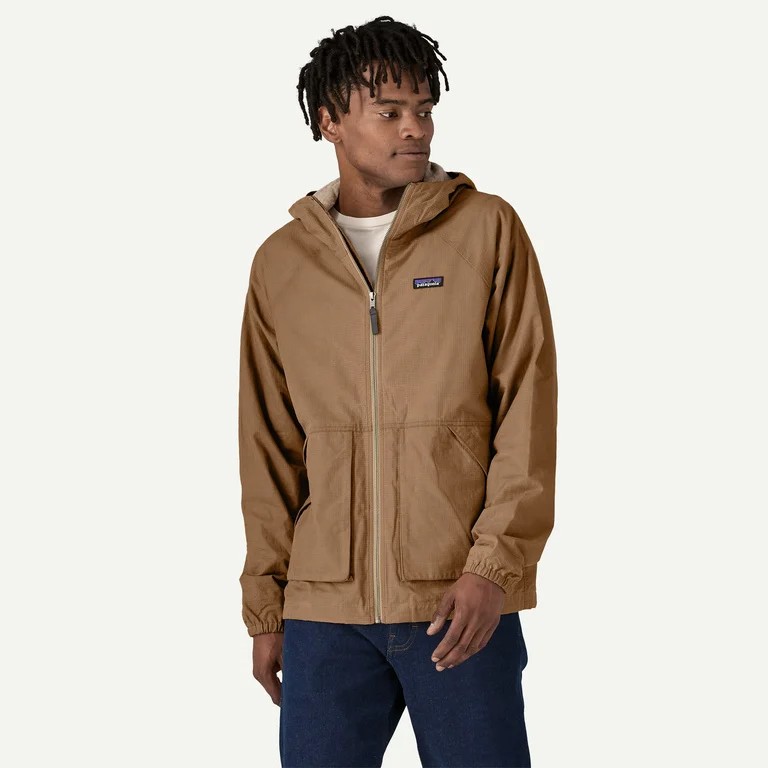
100% organic cotton ripstop, 55% hemp / 45% organic cotton lining · $369
Best overall. The only jacket here that tells you what is in the wax. Patagonia finishes organic cotton ripstop with Halley Stevensons EverWax Olive, which it describes as plant-based and paraffin-free, made from food-industry waste. The lining is hemp and organic cotton, so there is no synthetic anywhere in it. A three-panel hood, a zip-through collar and two snap bellows pockets make it the most rain-jacket-shaped piece on the list. It was 50% off when we checked, so look before you pay full price.
2. The Hatteras Anorak
Taylor Stitch

100% organic cotton · 11.5 oz dry wax canvas · $248
Best pullover anorak. The other organic cotton jacket on this list, and the pick if you want to pull it over your head rather than zip it. A hooded pullover anorak in 11.5 oz organic cotton canvas, dry-waxed for wind and water repellency, with underarm grommets and a drawcord hem. Organic cotton in outerwear is rare because outerwear is where brands reach for polyester and stop thinking about it. This is the piece to hold every other rain jacket up against.
3. Shelter Cloth Short Work Jacket
Filson

100% cotton shell, 100% cotton flannel lining · $349
Best for women. The cleanest construction here and the best of the women's options. Shell, lining and collar are all cotton: 11 oz oil-finish Shelter Cloth over brushed cotton flannel, with corduroy at the neck. That sounds unremarkable until you check what a lined jacket usually hides, which is a slick polyester taffeta nobody mentions on the label. The caped shoulder is a one-piece cut, so there is no seam across the part of you the rain lands on.
4. Marshall Jacket
Bridge & Burn

100% British Millerain waxed cotton, cotton flannel lining · $298
Best with a hood. The most jacket-shaped like a rain jacket of the ten: hip length, real hood, hand-warmer pockets, cut for a wet Portland winter by a brand that lives in one. The cloth is British Millerain, the Lancashire mill that has been waxing cotton since the 1880s. The only synthetic named anywhere on it is the hood drawcord. Made in a batch of 63, which is either the appeal or the problem depending on how fast you move.
5. Harbor Front Waxed Jacket
Filson

Waxed 100% cotton, brushed cotton flannel, cotton corduroy · $265
Best oversized barn coat. The oversized barn coat version, and the one that looks least like weather gear. Three components, three of them cotton: waxed cotton outside, brushed flannel inside, corduroy at the collar. Marsh tan is the neutral that goes over everything. Currently sitting well below its usual price, which for waxed cotton normally means last season rather than anything wrong with it.
6. Open Range Jacket
Rogue Territory

100% cotton · 10 oz dry wax canvas · Sewn in Los Angeles · $295
Best made in the USA. A slightly cropped chore jacket in 10 oz cotton dry wax canvas, unlined, sewn in Los Angeles. Unlined is the underrated part: there is no second fabric to check, so what you see on the label is the entire jacket. The dry wax keeps the water resistance and drops the tacky hand, which is what makes this one wearable indoors instead of hung by the door.
7. Dry Wax Short Cruiser Jacket
Filson

100% cotton · 7 oz dry wax · $199
Best under $200. The cheapest way into the category and the lightest weight of it. Seven ounces of dry-waxed cotton in a short trucker cut, unlined, one fiber start to finish. It is a spring and autumn jacket rather than a winter one, and it is the pick for anyone who wants to find out whether they like waxed cotton before spending three hundred dollars on the question.
8. Ranger Jacket
Rogue Territory

100% cotton · 10 oz dry wax canvas · Sewn in Los Angeles · $295
Best trucker cut. The same cloth as the Open Range in a trimmer trucker pattern, with gusseted shoulders so you can actually reach for something. Brown dry wax is the colorway that ages most visibly: waxed cotton creases where you fold it and lightens along the seams, which is either the reason to buy it or the reason not to.
9. The Sawyer Waxed Trucker Jacket
Marine Layer

100% cotton, corduroy collar and cuffs · $248
Best for everyday wear. The softest-looking one here and the easiest to wear to something that is not a chore. Trucker length, waxed cotton, corduroy at the collar and wrists. Worth knowing that Marine Layer sells a near-identical Glenn wax canvas bomber that is 70% cotton and 30% nylon, so the word waxed on the tag is not the thing to read. This is the one that is cotton.
10. Chiltern Cropped Jacket
Alex Mill

100% cotton shell · nylon body lining · $295
Best cropped shape. The one on this list that is a fashion jacket first: cropped, bell-sleeved, corduroy collar, brass buttons, based on a vintage hunting coat. The shell is waxed cotton and the score reflects it. The body lining is nylon, which is stated on the product page and is the compromise you are making here. If the point is getting the plastic out entirely, the Filsons above do it and this does not.
How to shop this category yourself
Read the lining, not the shell. Every jacket in a roundup like this has a cotton outer, because that is the whole premise. The differences are inside. Insulated waxed jackets are almost always filled with polyester, sleeve linings are almost always taffeta, and neither shows up in a headline that says waxed cotton.
"Waxed" is not a fiber. Waxed nylon exists and it is sold in the same aisle with the same heritage photography. So does a wax finish on a cotton-nylon blend. The word describes the finish, and it tells you nothing about what is underneath it.
Search "dry wax." It is the phrase the cleanest fabrics keep using. Dry wax cloth feels like ordinary canvas, does not transfer onto your other clothes, and on all three of the brands here it is stated as plain cotton with no coating over it.
Assume nothing about the wax. The tin is the one part of a waxed jacket nobody discloses. If a brand does not say paraffin-free, do not read it as paraffin-free. Right now that means asking, and it means noticing which brands answer. The certifications worth trusting cover the dye house and the fiber, not the wax, so none of them settle this one either.
The short version
The exemption is the tell. When a law bans PFAS in every kind of clothing except the kind designed to keep rain off you, it is admitting the industry does not yet know how to make a technical shell without them. That deadline is 2028.
You do not have to wait for it. The pre-technical version of a rain jacket still exists, still works for the weather most people are actually in, and is made of cotton and wax rather than plastic and fluorine. It will not get you down a mountain in a storm. It will get you to the train.
The rest of the natural fiber outerwear that clears the bar is in the shop, filed under women’s outerwear and men’s outerwear, and the organic cotton edit is where the cleanest fiber in the whole catalog lives.
If you already own a rain jacket and you have no idea what is on it, scan the label.
Frequently asked
Waxed cotton does not need PFAS to work, which is the important part. Water repellency comes from a wax sitting in and on the cotton weave rather than from a fluorinated coating, so the mechanism that carries PFAS in a technical shell is absent by design. That is a statement about how the fabric works, not a lab result. Almost no brand publishes what is in its wax, and only Patagonia does among the ten here, so the honest claim is that these jackets do not rely on the chemistry, not that anyone has tested them.
No. Waxed cotton is water-repellent, which means rain beads and rolls off for a while and then eventually soaks through. There is no membrane and no taped seam construction. For a commute, a dog walk, a drizzle or a downpour you are out in for twenty minutes, it works. For a day on a mountain it does not, and that is exactly the gap the PFAS exemption was written around.
Dry wax is a lighter finish that leaves the cloth feeling like ordinary canvas rather than tacky. Traditional waxed cotton carries more wax, feels slightly oily, transfers onto light-colored fabric and repels more water. Filson, Taylor Stitch and Rogue Territory all label their lightest weather cloth dry wax. If you want the look without the hand, that is the word to search for.
Do not wash it and do not dry-clean it. Water strips the wax and shrinks the cloth, and solvents take the finish off entirely. Brush or wipe it with a damp rag, and re-wax it every year or two if the water stops beading. Nearly every jacket here says spot clean only on the label for exactly this reason.
No. Four of these have one. The tradeoff is not hood versus no hood, it is repellent versus waterproof. What you give up by leaving the technical shell behind is the membrane, the taped seams and the ability to stay dry for hours, not the features.
In practice it means an outer layer with no fluorinated finish on it and a natural fiber underneath, which is what every jacket here is. A jacket is also the easiest garment to be relaxed about, because it sits over your other clothes rather than against skin all day. If contact is the thing you are managing, the layers underneath matter more than the coat, and the same reading applies: check the composition, then check what was applied on top of it.
Both, though the men's side is deeper. Three of the ten here are women's: two Filson jackets and the Alex Mill cropped one. Patagonia cuts its waxed jacket gender-inclusive, so it belongs on both lists. Waxed cotton sits in a heritage-workwear lane that most brands still cut for men first, so women's natural fiber outerwear stays the thinner shelf. It is worth sizing into the men's cuts if you like the oversized fit, since several of these are unisex in everything but the label.
Less than it does in a t-shirt, and it still counts. The score reflects the fiber and how it was grown, and an outer layer is worn over other clothes rather than against skin for hours. Only two jackets on this list are organic, which says more about how thin the supply is in outerwear than about the rest of the picks.

