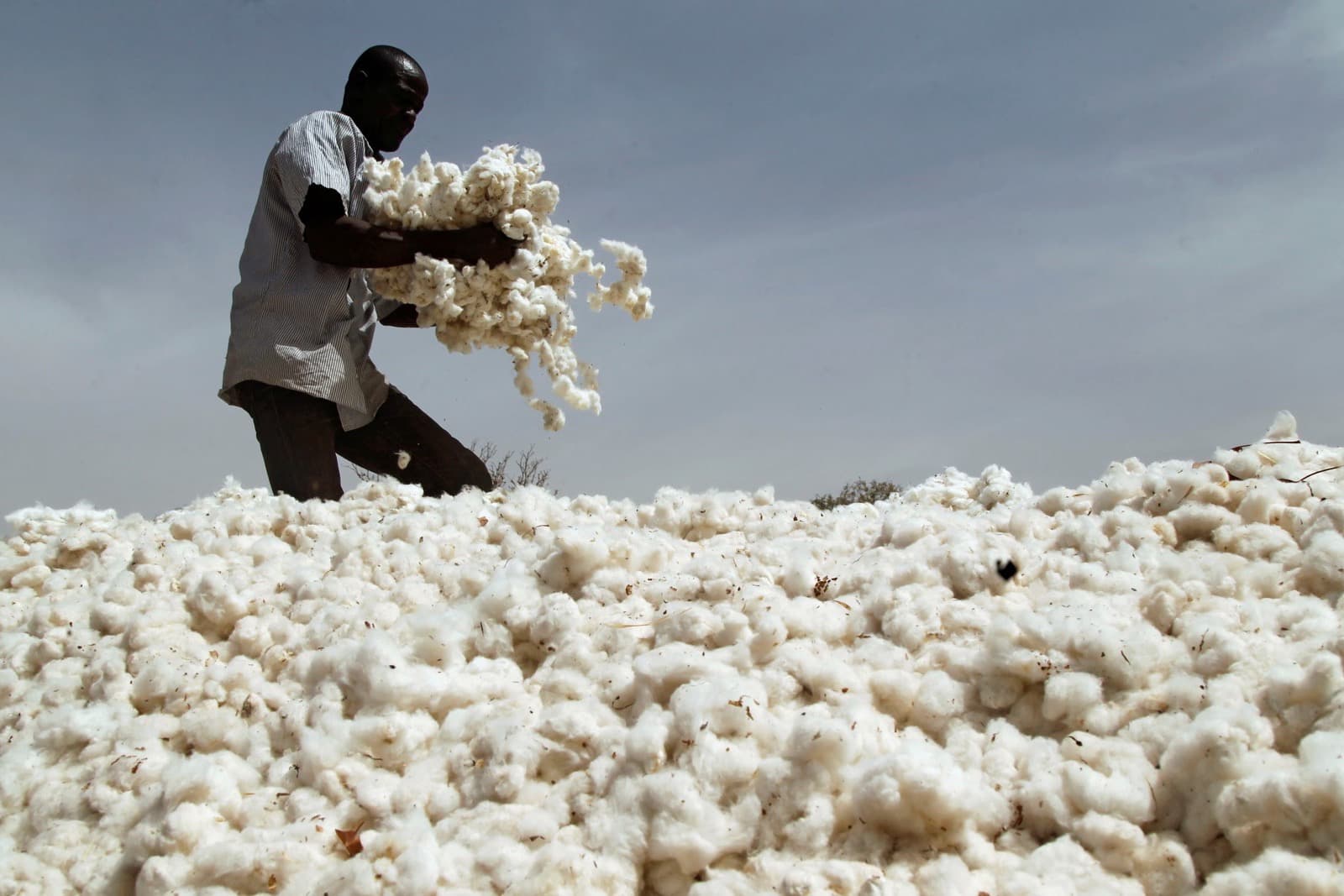
Cotton scores 84 out of 100 for wearer health on Toxome's fiber scale, where 100 is cleanest. That puts it in the safest band to wear. Cotton is the soft everyday plant fiber, but conventionally grown with heavy pesticides. The score rates the fiber, not the finished garment. Mills add dyes and finishes later, so check the label for those.
What is cotton?
Cotton is a soft fiber that grows on a plant, picked from a fluffy pod called a boll. But most regular cotton is sprayed with a lot of bug and weed killers while it grows, including a weed killer called glyphosate.
Cotton has been spun into cloth for at least 7,000 years, with the earliest known evidence from the Indus Valley and the Americas. It is the most widely grown natural fiber on Earth, and conventional cotton is also one of the most chemical-intensive crops farmed at scale.
How cotton is made
Sprayed through the season with insecticides and, on GM varieties, glyphosate.
A chemical pass near harvest drops the leaves so machines can pick clean.
Residue on picked fiber falls by roughly two thirds after two weeks of sun.
The hot alkaline wash before dyeing. No defoliant was detectable after it.
Wrinkle-free and no-iron mean a formaldehyde resin that off-gasses slowly.
Plain, unfinished cotton breathes well and holds onto very little.
Cotton grows in a fluffy pod called a boll on a shrubby plant that likes heat. Through the season, conventional cotton is sprayed with insecticides and herbicides, including the weed killer glyphosate on genetically modified varieties. Close to harvest it gets one more pass most shoppers never hear about: a chemical defoliant such as tribufos (sold as Folex or DEF), sprayed to drop the leaves so a machine can pick the bolls clean.
Here is the part the pesticide headlines leave out. When researchers measured four common defoliants on picked cotton, the residue had already fallen by roughly two-thirds after two weeks of sun and weather in the field, and none was detectable after scouring, the hot alkaline wash every cotton fabric goes through before it is dyed. On raw, unscoured fiber, tribufos and ethephon can still sit above OEKO-TEX Standard 100's limit of 5 mg per kilogram, so that wash step is doing real work between the field and your skin.
The chemistry that does reach you gets added at the end. Cotton labeled wrinkle-free, easy-care, or no-iron is treated with a formaldehyde-based resin that off-gasses slowly and can leave skin red and itchy, on top of whatever the dyes deposit. Plain, unfinished cotton breathes well and holds onto little.
Not all cotton is the same
Cotton on a label spans a huge range, and staple length, how long each individual fiber is, is what separates soft, durable cloth from something that pills in a month. Upland cotton, the vast majority of what is grown, has a short-to-medium staple. Pima, sold as Supima, and extra-long-staple (ELS) cotton, grown in places like the American Southwest, Peru, and Egypt, spins into a smoother, stronger, less pilly thread. A grade or provenance mark tells you about hand-feel and durability. It says nothing about pesticide use or finishing chemistry; the organic and GOTS labels answer that.
Is cotton safe to wear?
The cotton fiber against your skin is cellulose, biologically inert. The exposure that matters comes from what was added after the field: the formaldehyde-based resin behind wrinkle-free and no-iron labels, which is classed as a human carcinogen and can release into the air and irritate skin, plus dyes that leave residue sitting against you all day.
Cotton also carries one risk the numbers understate. You wear it more than anything else, and against bare skin: shirts, sheets, and underwear. A trace of leftover finish or dye on a single garment is minor. The same chemistry spread across most of your wardrobe adds up to more total contact than any other fiber.
The share of its own dry weight the fiber itself absorbs as water vapor, then releases into the air.
A fiber that can hold and release moisture is a fiber that feels dry against the skin. Polyester holds almost none, which is why a synthetic top feels clammy in the heat and cotton does not. Figures are the standard reference values for each fiber at 20°C and 65% humidity, not a measurement of any one garment.
- Breathable when untreated Plain, unfinished cotton lets air move freely against skin and stays comfortable in heat.
- Soft from day one Unlike stiffer plant fibers like linen or hemp, cotton feels soft straight off the shelf, with no breaking-in required.
- Absorbent Holds a good amount of moisture before it feels wet, which is part of why it is the default for towels, sheets, and underwear.
- Cleaner with organic and GOTS Skipping synthetic pesticides and controlling the finishing chemistry through GOTS removes most of what causes reactions in sensitive skin.

Conventional cotton starts from a skin-safe plant fiber, so its hazard base is low, but heavy field chemistry and formaldehyde-based finishes pull it down to 84 rather than up near linen and hemp. The way up is a certification: organic skips the synthetic pesticides and lifts it to 92, and Regenerative Organic Certified sits at the top of the cotton scale at 96. See the full method.
Doing this check on every product page yourself is the tedious part. The Toxome Chrome extension reads the composition for you while you shop, so you see whether something is cotton (and what else is in it) before you buy, not after it arrives.
How cotton affects the planet
Cotton's environmental problem is water. A single t-shirt can take around 2,700 litres to grow, and a kilo of fiber runs from roughly 3,000 litres under efficient US irrigation to well over 8,000 in thirstier regions.
Its carbon is moderate and varies with irrigation and the local power grid. The upside is that undyed cotton is a plant fiber, so it biodegrades and sheds no plastic.
Swings by country: efficient US irrigation near 2,250, thirstier regions near 8,600.
The Cotton Inc life-cycle study lands near 5.9; it varies with irrigation and the local power grid.
Undyed cotton is roughly 86% gone in 35 days in lab tests.
A plant fiber, not plastic.
Environmental figures are separate from the health score above, which reflects wearer health only. Numbers are per kilogram of finished fiber and rounded; see sources.
Who grows cotton
Around a fifth of the world's cotton comes from Xinjiang, China, where investigations have documented coercive labor moving Uyghur and other minority workers into the fields. That evidence is the basis of the US ban on Xinjiang cotton imports.
Cotton also uses a hugely disproportionate share of the world's pesticides, and the heaviest exposure falls on farmworkers in places where safety rules are weakest.
How to care for cotton
Shop Cotton



Cotton, answered
The plant fiber is not; it is inert cellulose. The real exposure comes from what gets added: formaldehyde-based wrinkle-free and easy-care finishes, and dye residue. The field pesticides and defoliants are mostly gone by the time cotton is scoured and made into cloth. Choose GOTS or OEKO-TEX Standard 100 certified cotton to screen the finishing chemistry too.
Plain, untreated, well-washed cotton is one of the safer everyday fabrics. Watch for wrinkle-free, no-iron, or stain-resistant labels; those usually mean a formaldehyde finish was added on top of the fiber.
For your skin, yes. Organic cotton skips the synthetic pesticides that show up as residue in lab tests on regular cotton, and pairing it with a GOTS label controls the dyeing and finishing too. It scores 92 versus conventional cotton's 84.
Pima, also sold as Supima, has a longer staple fiber than standard upland cotton, so it spins into a smoother, stronger, less pill-prone thread. That is a quality and durability difference, not a health one. Pesticide use and finishing chemistry are decided by organic and GOTS certification, not by the Pima name.
- FTC Seeks Largest-Ever Civil Penalty for Bogus Bamboo Marketing · U.S. Federal Trade Commission
- What Is GOTS Certified Organic Cotton · Q for Quinn
- PUREPRESS: wrinkle-free and formaldehyde-free durable press · Cotton Incorporated
- The Impact of a Cotton T-Shirt · World Wildlife Fund
- The Uyghur Genocide: An Examination of China's Breaches of the 1948 Genocide Convention · New Lines Institute
- The Deadly Chemicals in Cotton · Environmental Justice Foundation
The health score reflects wearer health only and mirrors the Toxome app. This guide is educational and is not medical advice.