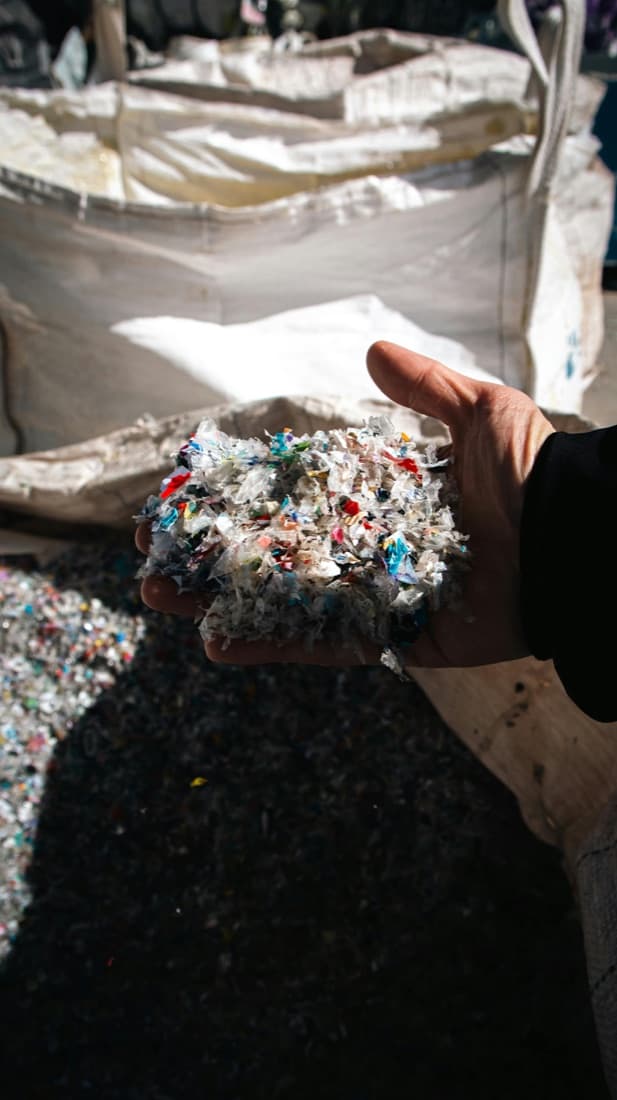
Polyester scores 30 out of 100 for wearer health on Toxome's fiber scale, where 100 is cleanest. That puts it in the band worth avoiding. Polyester is plastic thread, the same resin as water bottles, that sheds microfibers as you wear it. The score rates the fiber, not the finished garment. Mills add dyes and finishes later, so check the label for those.
What is polyester?
Polyester is plastic (the same kind used in water bottles) spun into thread. Most of it is made using a metal called antimony as a helper chemical, and some antimony stays behind in the finished fabric. The fabric is then colored with disperse dyes, which sit on top of the fiber instead of truly bonding to it.
British chemists John Rex Whinfield and James Dickson first made polyester in 1941. DuPont brought it to the US as Dacron in the early 1950s, and it is now the most produced fiber on earth by a wide margin.

How polyester is made
PET, the same plastic used in water bottles.
Antimony trioxide catalyzes the polymer, and about 200 ppm stays in the fiber.
Melted and pushed through tiny holes to form thread.
Drawn and set into the yarn that gets knit or woven.
Sits on the surface of the fiber instead of bonding into it.
The core problem is the fiber. It is plastic first, and everything follows.
Polyester is PET, the same plastic used in water bottles, melted and pushed through tiny holes to form thread. Most of it is polymerized with antimony trioxide as the catalyst, dosed at roughly 200 to 300 parts per million, and a residue of that antimony stays locked in the finished fiber (commonly measured around 200 ppm).
Once spun, polyester is almost always colored with disperse dyes, which sit on the surface of the fiber instead of bonding into it.
Polyester's core problem is the fiber, not any single additive. It is plastic first, and everything after that, the dye, the catalyst residue, the shedding, follows from being plastic against your skin.
Not all polyester is the same
Virgin polyester is spun from new petroleum. Recycled polyester (rPET) is spun from melted-down plastic bottles or textile waste instead. On paper that reads like the cleaner pick, and it does cut new oil extraction. By Toxome's scoring it lands a few points lower (more hazard) than virgin, because mixed-source recycled plastic can carry more contaminants, and researchers have found recycled polyester sheds microplastic at an equal or higher rate and can carry higher BPA. Recycled polyester is a resource choice, not a wearer-health upgrade.
Is polyester safe to wear?
Sweat pulls some of polyester's residual antimony into the moisture on your skin. Antimony trioxide is rated a possible human carcinogen (IARC group 2B), and more of it releases from tight, warm activewear where heat and sweat run highest.
Polyester is also the leading cause of disperse dye skin allergies, worst where the fabric rubs and you sweat, and it sheds microplastics, tiny plastic fragments, onto your skin and into your home's air with every wash. One study measured about 496,000 plastic fibers from a single 6 kg polyester wash load. The Center for Environmental Health separately found BPA, a hormone-disrupting chemical, in polyester-based activewear (sports bras and athletic shirts, usually polyester blended with spandex) at up to 40 times California's safe limit.
The share of its own dry weight the fiber itself absorbs as water vapor, then releases into the air.
A fiber that can hold and release moisture is a fiber that feels dry against the skin. Polyester holds a fraction of what wool and cotton do, which is why it goes clammy in the heat when they do not. Figures are the standard reference values for each fiber at 20°C and 65% humidity, not a measurement of any one garment.
Virgin polyester lands around 30, well inside the worth-avoiding band, and recycled polyester scores a few points lower still, around 26. Recycling cuts new oil use but does not remove the antimony or slow the shedding, and it can add contaminants to what is already in the plastic. See the full method.
Doing this check on every product page yourself is the tedious part. The Toxome Chrome extension reads the composition for you while you shop, so you see whether something is polyester (and what else is in it) before you buy, not after it arrives.
How polyester affects the planet
Polyester is the most solid set of numbers in this guide, and the news is not good. It made up 59 percent of all fiber produced in 2024, nearly six of every ten new garments, and the vast majority is virgin, fossil-based plastic.
It does not biodegrade. It persists for centuries, fragmenting into ever-smaller microplastic, and it sheds plastic fibers into your water and air with every wash.
Fossil-derived. Updated data now includes methane from crude extraction.
Persists for centuries, fragmenting into microplastic.
One 6kg wash sheds about 496,000 plastic microfibers (Napper and Thompson, Plymouth).
Environmental figures are separate from the health score above, which reflects wearer health only. Numbers are per kilogram of finished fiber and rounded; see sources.
The cost of cheap plastic clothing
Polyester is made from oil. Synthetic fiber production burns through a notable share of the world's oil and emits hundreds of millions of tonnes of CO2 a year.
Separately, most of the garment workers who sew fast-fashion polyester earn far below a living wage. These are two different facts about the same cheap product, not cause and effect.
How to care for polyester
Shop organic cotton & TENCEL lyocell Instead


Polyester, answered
It carries several real, if individually small, risks: residual antimony (a possible carcinogen) that migrates into sweat, disperse dyes that are the leading cause of textile skin allergies, and heavy microplastic shedding. None of it is dramatic per wear, but you wear polyester constantly.
Yes, most often through disperse dyes, the number one cause of clothing-related contact allergies, and through the heat and sweat the fabric traps, which irritates skin and speeds up how much chemical residue moves onto you.
Not for your skin. It reduces new oil extraction, which matters environmentally, but researchers have found recycled polyester can shed as much or more microplastic than virgin polyester and can carry higher BPA. Treat it as a resource choice, not a health upgrade.
No. As a plastic fiber it blocks airflow and traps heat and sweat against your skin, which is why it feels clammy in activewear and why chemical residue moves onto skin faster in it than in natural fibers.
- Antimony release from polyester textiles by artificial sweat solutions · Regulatory Toxicology and Pharmacology
- Contact allergy from disperse dyes in textiles - a review · Contact Dermatitis (Wiley)
- Recycled polyester microplastic emissions and BPA · Estroni
- Materials Market Report 2025 · Textile Exchange
- Release of synthetic microplastic plastic fibres from domestic washing machines · Marine Pollution Bulletin (Napper & Thompson)
- Living Wage · Clean Clothes Campaign
The health score reflects wearer health only and mirrors the Toxome app. This guide is educational and is not medical advice.