You read the label on your food. You read the ingredients on your face cream. Then you pull a new shirt over your head and never think to ask what is in it. That blind spot is not your fault. The fabric touching your skin all day is one of the least regulated things you own, and nobody handed you a way to check it. So here is one. You cannot see the chemicals in a garment, but you can learn to check if your clothes contain harmful chemicals the same way you learned to read a nutrition panel: one small tag at a time.
Step 1: Read the fiber content tag first
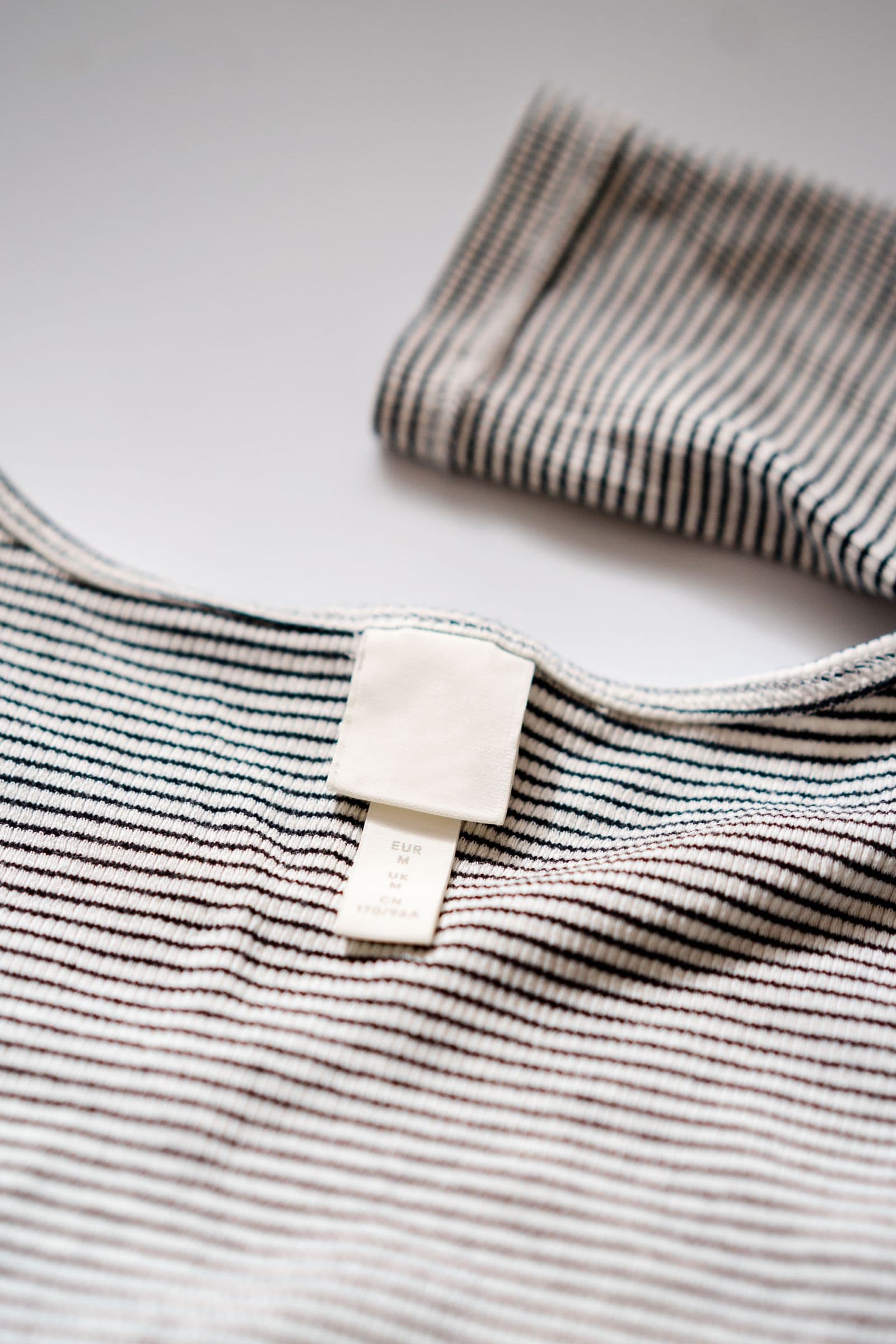
Flip to the inside seam and find the small tag that says something like 95% cotton, 5% elastane. This is your starting point, because the fiber decides the baseline.
Natural fibers, cotton, linen, hemp, wool, silk, are plant or animal in origin. They still get dyed and finished, so natural does not mean clean, but they are not plastic against your skin. Synthetic fibers, polyester, nylon, acrylic, and the stretch fiber spandex (also sold as elastane or Lycra), are made from petroleum. They are plastic, spun into thread. Most fast fashion is majority polyester, and synthetics are the fabrics most likely to carry the sprayed-on finishes that follow.
The quick read: the higher the natural-fiber percentage, the fewer chemical layers you are usually inviting onto your body. A 100% linen dress is a simpler object than a polyester one that promises to do six things.
This first read is exactly what the Toxome app does when you scan a garment. Point your camera at the composition tag, and it pulls out the fibers and scores what they mean for your skin before you buy.
Step 2: Read the marketing words like a chemist
This is the step most people skip. The features a label brags about are often the chemistry you are trying to spot. When a garment sells you a superpower, something was usually added to deliver it.
- Wrinkle-free, non-iron, easy-care, permanent press. These finishes are frequently built on formaldehyde-based resins, used to hold cotton smooth. The U.S. Government Accountability Office studied formaldehyde in clothing and found levels generally low, but flagged that it causes allergic contact dermatitis, an itchy rash, in sensitive people. It is the classic tradeoff of a crisp shirt that never needs ironing.
- Water-repellent, stain-resistant, quick-dry. These are the exact promises a fluorinated coating is engineered to keep. That coating can be PFAS, the so-called forever chemicals, which the U.S. EPA links to hormone disruption, thyroid disease, and reduced fertility.
- Anti-odor, antimicrobial, anti-stink. Usually a separate treatment, often silver-based, added to synthetic athletic wear.
You do not need a lab to use this. Just flip your instinct: a fabric selling you magic is a fabric to read more closely, not less. It is the reason the Toxome Score weighs the finish and not only the fiber, because a treated cotton and a plain one look identical on the composition tag.
Step 3: Look for a real certification
Because no law forces a full disclosure, a trustworthy third-party seal is the closest thing to an ingredient list you will find. Two are worth memorizing.
OEKO-TEX Standard 100 means the finished item, every thread and button, was tested against a list of more than 1,000 harmful substances and passed. It even sorts products by how much they touch you: the strictest limits apply to baby clothing, the loosest to a jacket lining. It is the single most useful mark to look for.
GOTS, the Global Organic Textile Standard, goes further for natural fibers. It certifies that the material is organically grown and that the dyeing and processing met strict chemical rules, banning formaldehyde and the riskiest dyes along the way.
Not every seal is worth the thread it is printed on, and some are pure marketing. We sorted the ones that hold up from the ones that do not in the Toxome certification guide.

A word on the dyes those standards screen out. A family of colorants called azo dyes can break down against warm skin into aromatic amines, some of which are known to cause cancer. The European Union restricts 22 of them in anything that touches skin for long, capping them at a trace threshold. The United States has no such rule, which is exactly why the seal does the work the law does not. If you want to see what color looks like without any of that chemistry, you can make fabric dye out of food waste in about an hour.
Step 4: Use your nose, carefully
Your senses are a rough instrument, but not a useless one. A strong chemical smell on a new garment, that sharp plastic or solvent note when you open the package, is a genuine signal that finishing chemicals are off-gassing. A well-known one is the fishy or kerosene odor tied to certain finishing agents.
Treat smell as a red flag, never as an all-clear. Plenty of chemistry has no scent at all, so a garment that smells like nothing can still be treated. If it does smell, believe it. This is the one check Toxome cannot run for you. A scan reads the label and flags a treated synthetic; your nose catches the off-gassing a photo never will. Use both.
Step 5: Wash before the first wear, every time
This one is a habit more than an inspection, and it is the easiest win on the list. Washing a new garment before you wear it rinses away a meaningful share of the surface residues, the loose dye, the water-soluble finishing agents, sitting on top of the fabric. It will not strip a bonded coating like a PFAS treatment, which is built to survive the wash. But for the everyday residues that cause most skin reactions, one cycle before first contact is a small ritual that pays off. Think of it as the last step of the same habit: Toxome tells you what a garment is before you buy it, and the first wash clears the loose residue off what you already own.
What this means for your closet
You do not have to audit everything you own tonight. Start where the contact is longest and the skin is most sensitive: what you sleep in, what you work out in, what sits against your body all day. Check the fiber tag, read the marketing words with new eyes, look for a seal, trust a bad smell, and wash the new thing first. Five moves, and you already know more about your clothes than you did this morning.
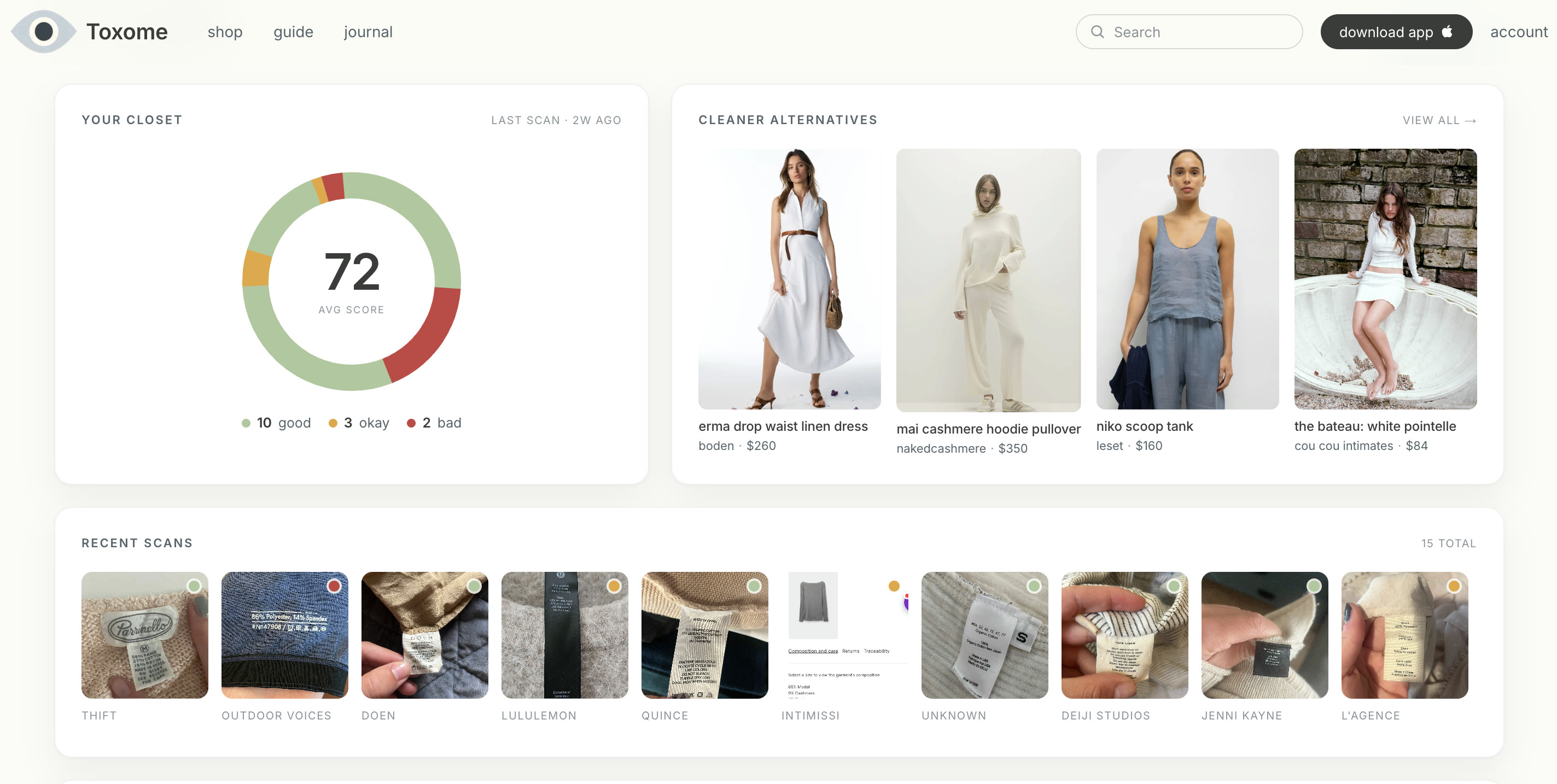
Your closet
Do a Closet Detox.
Scan the pieces you already own and Toxome gives you a Closet Score, one number for how clean your wardrobe runs, plus cleaner swaps for whatever ranks worst.
Get your Closet ScoreThe clothes you wear are a health choice, the same way food is, and for too long nobody gave you the information to make it. Reading the label is where it starts. And when you would rather not decode a tag in a fitting room, you can point a camera at the composition label and let it read the fibers and finishes for you, so the answer arrives before the garment ever touches your skin. Either way, the goal is the same. Know what's in your clothes, then choose on purpose.
Sources
- U.S. Government Accountability Office. (2010). Formaldehyde in Textiles. GAO-10-875. https://www.gao.gov/products/gao-10-875
- European Chemicals Agency (ECHA). REACH Annex XVII, Entry 43: azo dyes releasing listed aromatic amines. https://echa.europa.eu/substances-restricted-under-reach
- U.S. EPA. (2024). Our Current Understanding of the Human Health and Environmental Effects of PFAS. https://www.epa.gov/pfas/our-current-understanding-human-health-and-environmental-effects-pfas
- OEKO-TEX. STANDARD 100. https://www.oeko-tex.com/en/our-standards/oeko-tex-standard-100/
- Global Organic Textile Standard (GOTS). The Standard. https://global-standard.org/the-standard
- California AB 1817. (2022, effective 2025). Textile articles: PFAS. https://leginfo.legislature.ca.gov/faces/billTextClient.xhtml?bill_id=202120220AB1817