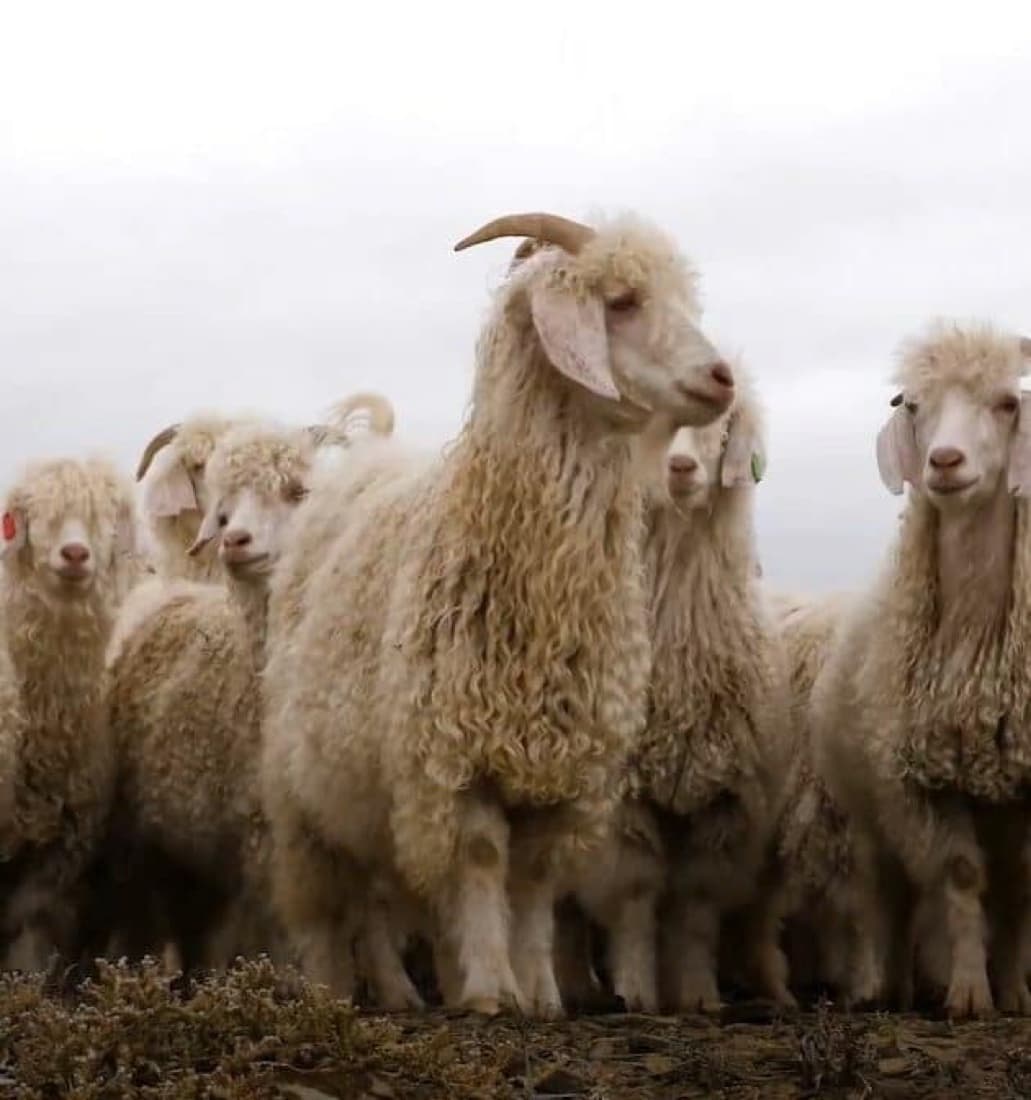
Mohair scores 78 out of 100 for wearer health on Toxome's fiber scale, where 100 is cleanest. That puts it in the safest band to wear. Mohair is a warm, glossy goat fiber; check for animal welfare and no harsh anti-shrink finish. The score rates the fiber, not the finished garment. Mills add dyes and finishes later, so check the label for those.
What is mohair?
Mohair comes from the Angora goat, not the Angora rabbit, a mix-up that trips up a lot of shoppers. The name likely traces to the Arabic mukhayyar, meaning choice or select cloth.
Angora goats originated near Ankara, Turkey, and the fiber trade spread from there to South Africa and Texas, which today produce most of the world's mohair alongside Turkey.
How mohair is made
Shorn twice a year, more fiber per animal than most specialty breeds.
The 2018 footage from South African farms is why the RMS standard exists.
Washed to strip grease and dirt. No heavy dehairing needed.
Sorted by age and fineness. Kid mohair, under a year old, is the finest.
Surface scales lie flat, which is what gives mohair its shine.
Close to inert against skin. The wearer-side risk is dye and finish.
Mohair comes off the Angora goat twice a year, more fiber per animal than most specialty breeds. Goats under a year old give the finest fleece, kid mohair, and each later shearing grows progressively coarser. The shorn fleece is scoured to strip grease and dirt, then graded by age and fineness. Mohair skips the heavy dehairing cashmere needs, since Angora goats do not grow the same coat of coarse guard hairs.
Welfare is mohair's defining pressure point. In 2018 PETA released footage from a dozen South African farms, the source of more than half the world's mohair, showing goats dragged by the horns and legs and roughly handled during shearing. Within days H&M, Gap, and the owners of Zara and Topshop pledged to drop the fiber, most aiming mohair-free by 2020. The industry answer was the Responsible Mohair Standard (RMS), launched by Textile Exchange in March 2020 and modeled on the wool standard, certifying farms on animal welfare and land use.
On the fiber side the story is calmer. Mohair's surface scales lie flat, so it is close to inert against skin. The real wearer-side risk is added later, in the dyes and finishes, not in the fleece.
Not all mohair is the same
Mohair is graded mainly by the goat's age at shearing, which tracks fiber width. Kid mohair, from goats under one year, runs about 20 to 24 microns, fine and silky. Young goat mohair sits in the mid-20s to low-30s. Adult mohair, from older goats, reaches 39 microns or coarser, better suited to rugs, upholstery, and outerwear than next-to-skin wear.
Is mohair safe to wear?
Mohair's scratch is about which mohair and how it was woven, not an allergy. Its fiber scales lie flatter and smoother than sheep wool's, so strand for strand it rubs against skin less than wool of the same thickness.
The catch is mohair's length and its signature fuzzy halo: a lot of fiber ends stick out of the yarn, and past a certain thickness those ends poke the skin's nerve endings, the same prickle behind any animal-fiber itch, not an immune reaction. Kid mohair, thinner and silkier, rarely bothers sensitive skin the way coarse adult mohair in a heavily brushed weave can. The one chemical thing to check is dye: an OEKO-TEX STANDARD 100 label rules out the problem dyes and residues that would otherwise be the fiber's only real hazard.
- Smoother scales than wool Lies flatter against skin strand for strand, so at a comparable thickness it feels less irritating than sheep wool.
- Lustrous and durable Takes dye brilliantly and holds its shape and shine over years of wear, so a mohair piece tends to last.
- Breathable insulation Regulates temperature well, insulating in cold without feeling heavy.

Mohair's undyed fiber starts clean, a hazard base close to other animal fibers, which lands it in the high green band near 78. Prickle from a coarse halo is a comfort tradeoff, not a health risk on its own; the dye and finishing chemistry layered on afterward is what lowers a given piece. See the full method.
Doing this check on every product page yourself is the tedious part. The Toxome Chrome extension reads the composition for you while you shop, so you see whether something is mohair (and what else is in it) before you buy, not after it arrives.
How to care for mohair
Shop Mohair

Mohair, answered
It depends on the grade and weave. Kid mohair, from goats under one year old, is fine and silky. Coarser mohair from older goats, especially in a heavily brushed, fuzzy weave, can prickle the way any thick animal fiber does.
No, and this is the common mix-up. Mohair comes from the Angora goat. Angora fiber comes from the Angora rabbit, a different, much finer and fluffier fiber.
It came under real scrutiny after a 2018 PETA investigation of South African farms pushed major retailers to drop it. The industry response is the Responsible Mohair Standard (RMS), launched in 2020, which certifies farms on animal welfare and land use. Look for RMS if welfare matters to you.
There is no strong evidence of a true mohair allergy. Discomfort is almost always prickle from a thick or heavily brushed weave, not an immune reaction, so fine kid mohair in a smooth weave is a reasonable choice even for sensitive skin.
- The Touch of Mohair · Churchmouse Yarns & Teas
- Is Mohair Itchy? Causes and Allergy Solutions · Wyndly
- Mohair · Wikipedia
The health score reflects wearer health only and mirrors the Toxome app. This guide is educational and is not medical advice.