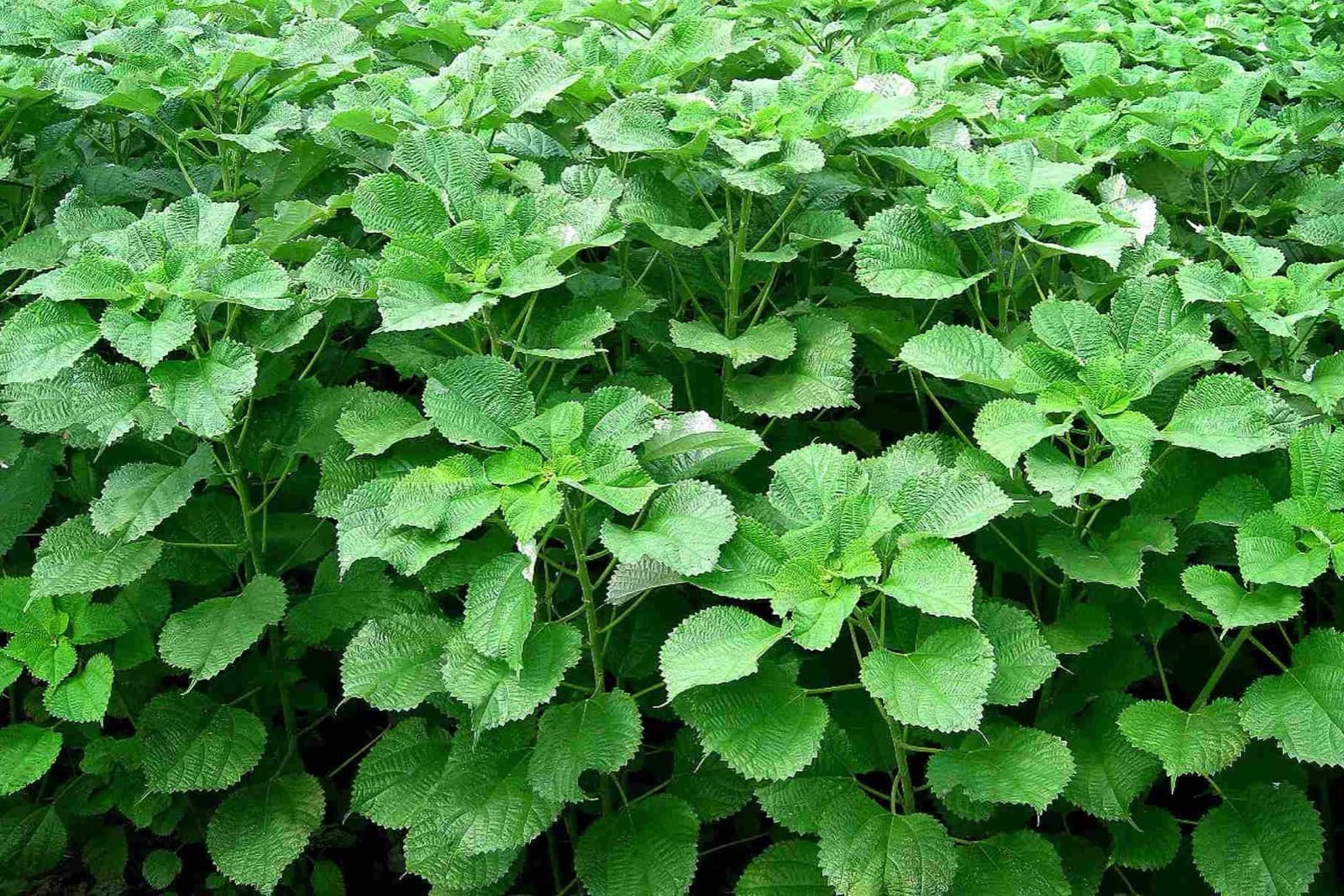
Ramie scores 90 out of 100 for wearer health on Toxome's fiber scale, where 100 is cleanest. That puts it in the safest band to wear. Ramie is a strong, linen-like plant fiber that breathes and resists mildew. The score rates the fiber, not the finished garment. Mills add dyes and finishes later, so check the label for those.
What is ramie?
Ramie is a bast fiber from a plant in the nettle family, though this cousin does not sting. The fiber is exceptional: long, lustrous, and stronger than flax, cotton, or wool, and it holds that strength when wet. It stays niche for one reason, and that reason is the whole story of the fabric.
Ramie is one of the oldest fibers in cultivation, grown in China for thousands of years, where it earned the name China grass. It was used to wrap Egyptian mummies alongside linen, and it is sometimes called the queen of fibres for its luster and tensile strength.
How ramie is made
A bast fiber cut from the stalk, like flax but far gummier.
Raw ramie is 25 to 35 percent gum, too much to ret and comb.
A boiling caustic soda bath strips the gum, or newer enzymes do it gently.
Alkali left on the fiber irritates skin, so the rinse has to be thorough.
Usually spun with cotton or linen to borrow softness and hide the stiffness.
Done well, either route rinses clean. Done cheaply, you feel it.
Ramie's problem is gum. Raw ramie bast is 25 to 35 percent gum by weight, a mix of pectin, hemicellulose, and lignin that cements the fiber to the stalk. That is far more than flax carries, and it is why ramie cannot be retted and combed the way linen is. The gum has to be forcibly stripped, a step called degumming.
The conventional route is a strong alkaline bath: caustic soda (sodium hydroxide) at roughly 8 to 15 percent, boiled, to cut the residual gum down to a few percent so the fiber will spin. It works, and it is where ramie's environmental cost lives, in heavily alkaline wastewater that has to be treated.
That same bath is the health question. Strong alkali left on the fiber will irritate skin, so it has to be rinsed out completely. Newer enzyme and microbial degumming does the same job more gently, and it softens the fiber's signature stiffness at the same time. Done thoroughly, either route rinses clean. Done cheaply, to save time and water, you feel it.
Because degumming is slow, expensive, and easy to do badly, most ramie reaches you blended, with cotton or linen, to borrow some softness and hide the stiffness.
Not all ramie is the same
Ramie carries no regional provenance mark the way linen does. The quality split that matters is how it was degummed. Enzyme or bio-degummed ramie is measurably smoother and less pokey, while conventionally degummed ramie stays stiffer and can carry more residue if the alkali bath was not fully rinsed.
Is ramie safe to wear?
The fiber itself is comfortable to wear: airy, fast-drying, and resistant to mildew and odor-causing bacteria. The first honest tradeoff is prickle. Ramie is stiff, and its hard surface hairs physically poke the nerve endings right under your skin. One study found enzyme-softening cut that discomfort by almost 44 percent.
The second is leftover chemistry. Degumming ramie takes a strong caustic bath, and any alkali not fully rinsed out sits against your skin. Done right, the fiber comes out clean. Done cheaply, you feel it twice, as stiffness and as residue.
- Exceptionally strong Stronger than flax, cotton, or wool, and one of the few fibers that gains strength when wet, so a well-made ramie piece lasts.
- Breathes and dries fast Moves heat and moisture off skin quickly, which keeps it comfortable in heat and humidity.
- Resists mildew and bacteria Its structure holds onto less moisture, so it collects less mold and odor than damper-feeling fabrics.
- Softens with the right process Enzyme-degummed ramie loses most of its scratch, cutting the fiber's natural prickle by close to half versus untreated fiber.

Ramie starts as a strong, high-yield plant fiber, so its hazard base is low, near hemp and linen. It lands at 90 rather than higher because the degumming step is unavoidable and harsh: unlike flax's simple water-retting, ramie needs a strong caustic bath that, done cheaply, is more likely to leave residue behind. See the full method.
Doing this check on every product page yourself is the tedious part. The Toxome Chrome extension reads the composition for you while you shop, so you see whether something is ramie (and what else is in it) before you buy, not after it arrives.
How to care for ramie
Shop Ramie




Ramie, answered
Not from the fiber itself. The health question with ramie is how thoroughly the strong caustic degumming bath was rinsed out, since leftover alkali can irritate skin. Done well, almost nothing remains. Look for OEKO-TEX Standard 100 or enzyme-degummed ramie to confirm.
It can be. Ramie is a stiff fiber, and its surface hairs can poke the nerves under your skin, a feeling called prickle. Enzyme-softened ramie cuts that discomfort by close to half; raw, conventionally processed ramie stays scratchier.
They look similar and are both bast fibers, but ramie is whiter, more lustrous, and stronger, especially when wet. The tradeoffs are that ramie is stiffer, has less stretch, and creases more, which is why it is often blended with linen or cotton rather than used alone.
Yes. It is airy, dries fast, and resists mildew and odor, which makes it a good warm-weather fiber once it has been properly softened.
- Synergistic Multi-Enzyme Modification of Ramie Fabric · Textiles (MDPI)
- An Effective Degumming Enzyme from Bacillus sp. Y1 · NCBI / PMC
- Define Ramie: Properties, Uses & Natural Fiber Guide · Szoneier Fabrics
The health score reflects wearer health only and mirrors the Toxome app. This guide is educational and is not medical advice.