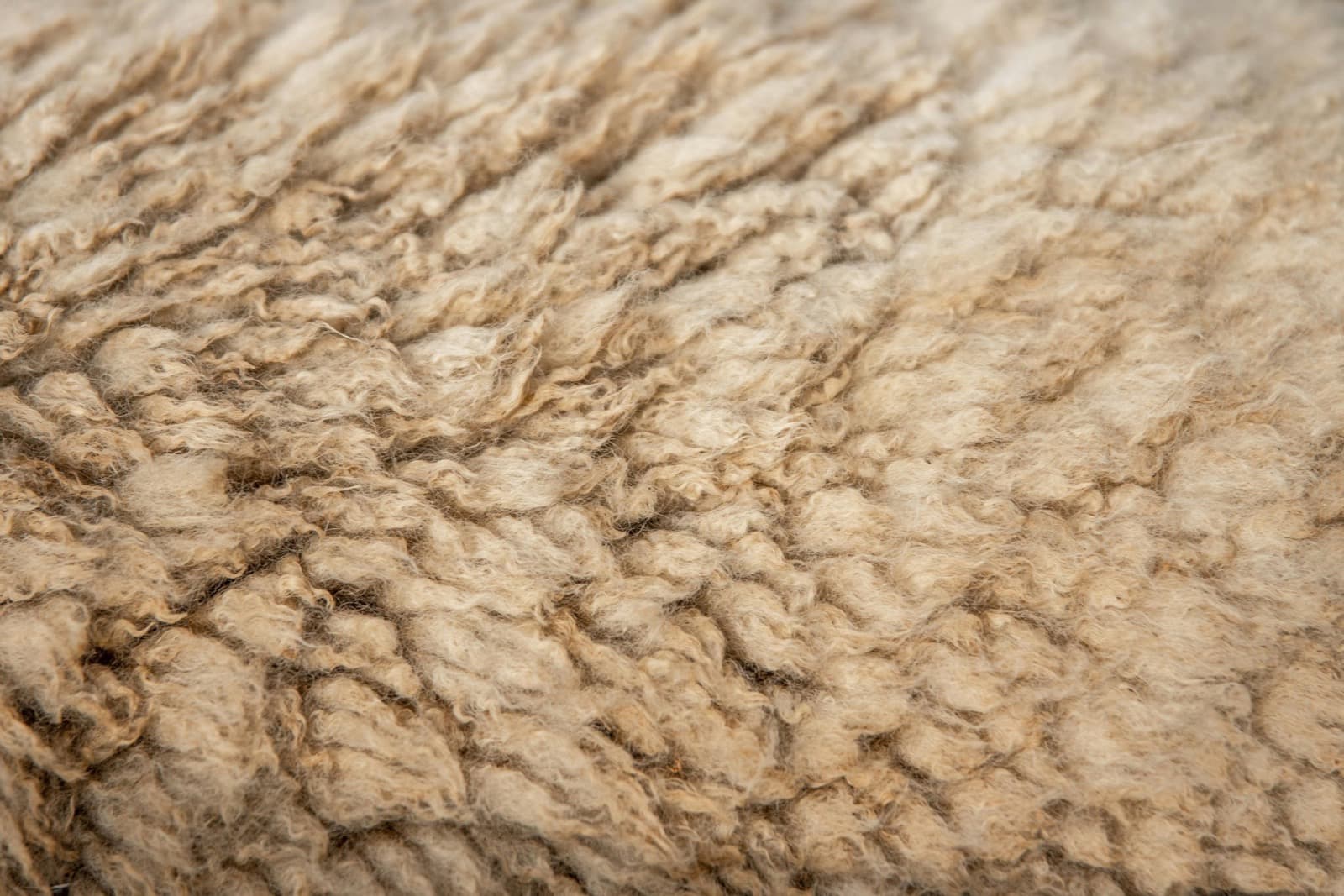
You have probably done it once. A wool sweater goes into the machine on the wrong cycle and comes out sized for a doll. It is one of the few laundry disasters that feels like a law of nature.
So if wool shrinks, how is there a whole shelf of wool that doesn't?
Someone did something to it. The process has a name, superwash, and it appears on almost none of the labels of the garments that have been through it.
Superwash wool is wool that has been chemically treated so it can survive a washing machine without felting. In the dominant method the mill strips the fiber with chlorine, then seals it under a synthetic resin. Neither step has to appear on a tag.
Why wool shrinks in the first place
Under a microscope, a wool fiber is not smooth. It is covered in tiny overlapping scales, like roof tiles, all lying the same direction. Add heat, water and the tumbling of a washing machine and those scales catch on each other and ratchet closer together. They cannot slide back out. That is felting, and it is why the sweater comes out dense and past saving.
Every animal fiber does this. Sheep wool, merino, cashmere, alpaca. The scales are the whole reason.
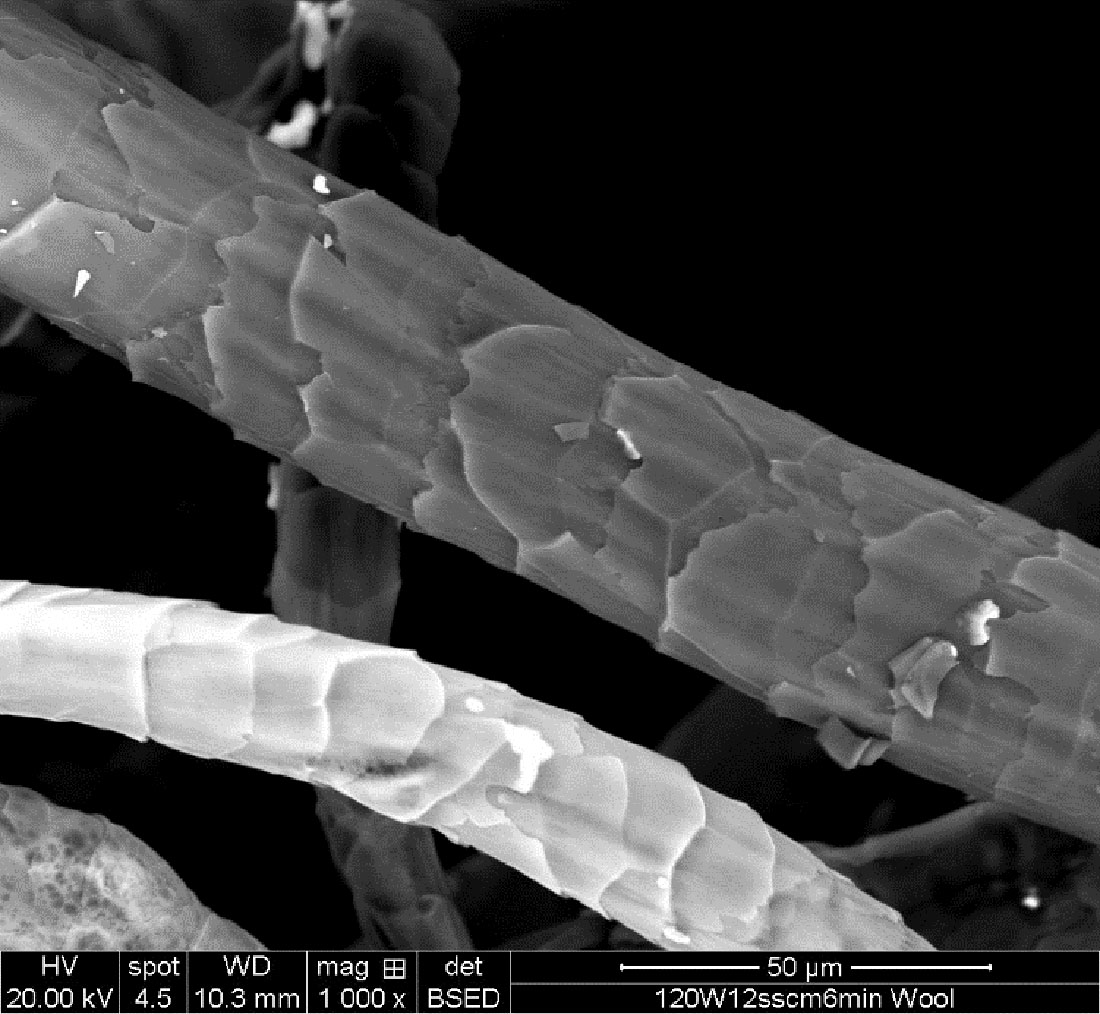
Making wool survive a washing machine means doing something about those scales.
What superwash does to the wool
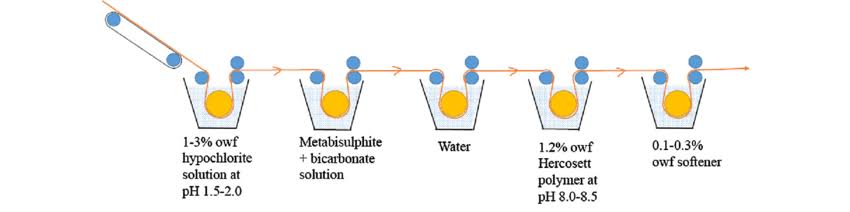
The industry standard method is called chlorine-Hercosett. Roughly 70 percent of machine-washable wool goes through it, according to a review of wool shrink-resistance methods by Mohammad Hassan and Christopher Carr published in the Journal of Advanced Research.
It runs in three stages. The third one is the one nobody mentions.
First, the mill bathes the wool in chlorine. This burns the edges off the scales. It also strips away a waxy layer bound to the outside of every wool fiber, called 18-MEA, the layer that makes wool water-repellent on its own. Once that is gone the fiber turns absorbent, which is what the next stage needs.
Second, they coat the stripped fiber in a synthetic resin. Its full name is polyamide-epichlorohydrin, sold to mills as Hercosett. It fills the gaps between the flattened scales so they can no longer catch on each other. It goes on at one to two percent of the fiber's weight, which sounds like nothing and is enough to form a continuous film over every strand.
Third, they add a silicone softener. Chlorine and resin leave the fiber rough, so silicone goes on top to put the softness back. The published recipe includes it as a standard step, not an optional extra.
A brand can label that sweater 100 percent wool, accurately and within the law, while it carries two synthetic finishes no tag has to declare.
No rule requires a fabric to tell you what was put on it. Only what it was made from.
Food carries an ingredient list. The fiber pressed against your neck for eight hours carries a tag that stops at the fiber and says nothing about the chemistry applied afterward. It is the same gap that lets a legging call itself cotton while spandex does the work, and the reason reading a composition label only gets you halfway.
Where the internet gets this wrong
Search superwash wool and you will find the claim that the plastic coating sheds into your washing machine as microplastics. It sounds right, and it gets repeated a lot. The only direct testing that exists points the other way.
Researchers put untreated wool, chlorine-Hercosett wool, viscose, polyester, nylon and polypropylene through a seawater biodegradation test and published the results in Water, Air, & Soil Pollution in 2024. Both wools broke down. The treated wool broke down more completely than the untreated wool, and the three synthetics showed almost nothing. When the researchers examined what was left behind, they found no sign that the coated wool had shed undegraded fragments.
The caveats matter. That work came out of a research institute with wool industry backing, and it measured breakdown in seawater rather than shedding during a wash cycle. It is still the evidence on the table, and it does not support the frightening version.
We would rather hand you that than let you repeat something we cannot stand behind.
What is worth knowing instead
Three things deserve the worry that microplastics were getting. The first is where the process happens. Both the chlorine stage and the resin stage produce a class of chlorinated waste called AOX, which is toxic and lingers in water. European and American discharge limits are strict enough that the process exceeds them, so mills have moved superwash production to countries where those limits are looser. Nobody solved that pollution. They relocated it.
The permitted limits give you the scale of it. GOTS allows 5 milligrams of AOX per kilogram in a finished product. The EU Ecolabel and China's national textile standard both allow 250 for man-made fibers, fifty times more. Those numbers exist because the residue turns up in cloth on the shelf, not only in factory wastewater. A 2022 analysis in the Chinese Journal of Chromatography measured chlorinated organic residues above 25 milligrams per kilogram in ordinary retail fabric.
Patagonia went further than the regulators, and did it early. The company has refused chlorine-treated wool since at least 2009, when it switched its merino base layers to an ozone process that shaves only the barbed tips off the scales and runs closed, so nothing vents. In a position paper it argues that the chlorine route leaves wastewater with unacceptably high levels of adsorbable organohalogens, and puts the case in blunt terms. Dioxins, which it describes as a group of AOX, are among the most toxic substances known and can be deadly to humans at levels below one part per trillion. It says the effluent is refused by most treatment plants in the United States, so most chlorinated wool is processed abroad and imported.
Then the same paper draws a line we should draw too. It states that garments made from chlorine-treated wool pose no risk to the wearer, and that "the final product is not the issue." The objection is to what the process does to water, not to what the sweater does to you. Patagonia sells chlorine-free wool and is not a neutral party here, and we have found no peer-reviewed work measuring dioxin formation from wool chlorination in particular. What is not in dispute is that a company with the volume to buy any wool it wants looked at this process, decided against it, and paid more for ozone and hydrogen peroxide instead.
The second is what the treatment costs the fiber. That waxy outer layer the chlorine strips off is the reason wool repels water and resists odor. Superwash wool pills faster and stretches out sooner, because the scales no longer grip and the natural surface is gone. You trade some of what makes wool worth buying for the convenience of a machine cycle.
The third is the chemistry nobody has measured. Epichlorohydrin, one of the two building blocks of the Hercosett resin, is classified by the International Agency for Research on Cancer as Group 2A, probably carcinogenic to humans. That sounds worse than the evidence supports. Once the resin cures, the epichlorohydrin has reacted into a different and far less reactive substance, and a cured polymer is not a jar of monomer. The open question is how much unreacted residue stays in a finished garment, and how much of it comes off against warm, damp skin over years of wear. No rule requires that answer, so nobody has produced it.
A regulatory question is forming too. New European rules define a restricted microplastic as a synthetic polymer that either makes up one percent of a particle or forms a continuous coating on it. Hercosett does both. The one thing keeping it outside that definition is an exemption for polymers that break down, which is what the 2024 study set out to establish. Regulators have not closed the question.
Does the same thing happen to cashmere?
The mechanism transfers. Cashmere has the same scales and can be descaled the same way, and published research has done it.
But it is much less likely to have happened to the cashmere in your closet. The treatment costs cashmere the exact softness people pay a thirty-fold premium for, so most cashmere brands skip it and tell you to hand wash instead.
Machine washable on a cashmere label usually points to the care instruction rather than a treatment. Cold water, gentle cycle, mesh bag. Untreated cashmere survives that fine. The next likeliest explanation is a blend, where nylon or superwash wool does the work. A real descaling treatment sits last on that list, and turns up mostly at the cheap end of the shelf.
The tell that works on merino socks and base layers does not carry over. With cashmere, ask instead whether the price makes sense for the fiber on the label. Our cashmere guide has the composition ranges worth expecting at each price.
What to look for
One cross-check does most of the work. GOTS certification prohibits chlorination of wool at any stage of production. A garment cannot be GOTS certified and conventionally superwashed at the same time. If a brand claims both organic certification and machine washability, either they are using an alternative process or the claim does not hold.
Clean alternatives exist. One method uses plasma, which is electricity and air, with no chlorine and no wastewater. It carries GOTS certification and mills sell it today. A second process swaps the chlorine for natural salts and sells as EXP. Brands paying for either tend to say so, because it costs more and it earns them something to advertise.
One label will not settle it for you. OEKO-TEX tests a finished garment against a list of restricted substances, which is worth having, but it certifies the product rather than the process. A superwashed sweater can carry it.
That gives you a quiet rule for the shelf. On machine-washable wool, silence about the method is itself information.
Read the care label next to the composition label, and treat them as one sentence rather than two. Wool that promises to survive a machine has been through something to earn that. You are allowed to want to know what.
Frequently asked
Not for you to wear. Patagonia, which refuses the process, says in its own position paper that garments made from chlorine-treated wool pose no risk to the wearer. The objection is to production. The chlorine stage generates AOX, a class of chlorinated waste that is toxic in water, and discharge limits in Europe and the United States are strict enough that mills moved the work to countries where the rules are looser. The cost to you is to the fiber itself: superwash wool pills faster and loses the natural surface that makes wool repel water and resist odor.
Merino wool is a protein fiber, closer to your own hair than to anything synthetic, and it is one of the cleanest fibers you can wear. The question worth asking is not about the wool but about what was applied to it. Roughly 70 percent of machine-washable wool has been through the chlorine-Hercosett process, which strips the fiber with chlorine and seals it in a polyamide-epichlorohydrin resin at one to two percent of its weight. Untreated merino carries none of that.
Cashmere is a natural protein fiber and it is rarely superwashed, because the treatment costs cashmere the softness people pay a large premium for. Most cashmere brands skip it and tell you to hand wash instead. When a cashmere label says machine washable, it usually means the care instruction rather than a chemical treatment, and the next likeliest explanation is a blend with nylon or superwash wool. Check the composition and whether the price makes sense for the fiber on the label.
That is the point of the treatment. Wool shrinks because tiny overlapping scales on each fiber catch on each other under heat and agitation, a process called felting. Superwash burns the edges off those scales and coats over the gaps, so the fibers slide instead of locking. Superwash wool still stretches out sooner and pills faster than untreated wool, because the scales no longer grip.
The care label is the tell. Machine washable on a 100 percent wool garment means the fiber was treated, because untreated wool does not survive a machine cycle. Hand wash only or dry clean only almost always means untreated fiber. Superwash is not required to appear on any tag in any country, so silence about the method is itself information. GOTS certification rules out chlorine superwash, since GOTS prohibits chlorination of wool at every stage.
Legally, yes. Fiber content labeling covers what the garment is made from, not what was applied to it afterward. A superwashed sweater carries a synthetic resin coating and often a silicone softener on top, and neither has to be declared. Food carries an ingredient list. Fabric stops at the fiber.


