Corporate Office Siren
The sharpest look in the office runs on fabric, and almost everything sold for it is plastic.
4 min read

Office siren is a look built almost entirely out of restraint. A trouser with a sharp line. A shirt with enough body that it holds its shape instead of clinging. A blazer that hangs off the shoulder rather than gripping it. Nothing about it is loud, and that is exactly why it cannot be faked.
Because a silhouette this spare has nowhere to hide, and what gives it away is always the cloth. The same trouser reads expensive in linen or wool and reads like a uniform in polyester, and the difference is visible from across a room. Drape is a property of fiber. A flat, slightly plastic sheen is also a property of fiber. You can spend a lot of money and still buy the second one.
There is a duller reason to care too. This is the outfit you are in for nine or ten hours, indoors, under lights, often without a window that opens. Polyester does not absorb moisture, so heat and sweat sit between the fabric and your skin all day rather than moving out through it. That is not a scare story, it is just what the fiber does. Here is the look, built out of cloth that breathes.
The trouser does most of the work
Get the trouser right and the rest of the outfit almost assembles itself. What you want is weight and a dry hand: linen, hemp, or a linen-silk twill, cut with a flat front or a single pleat and enough length to break properly over a shoe. That cloth is what holds the crease and gives you the long clean line the whole look depends on.
What you are avoiding is the polyester-viscose blend that dominates the workwear rack, which is cheap to produce, holds a press until the first warm room, and then goes limp. Every trouser below is a named natural fiber at 100%, or the Eileen Fisher linen-silk twill, which is the one blend worth making an exception for: silk gives linen a fluidity it cannot get on its own.


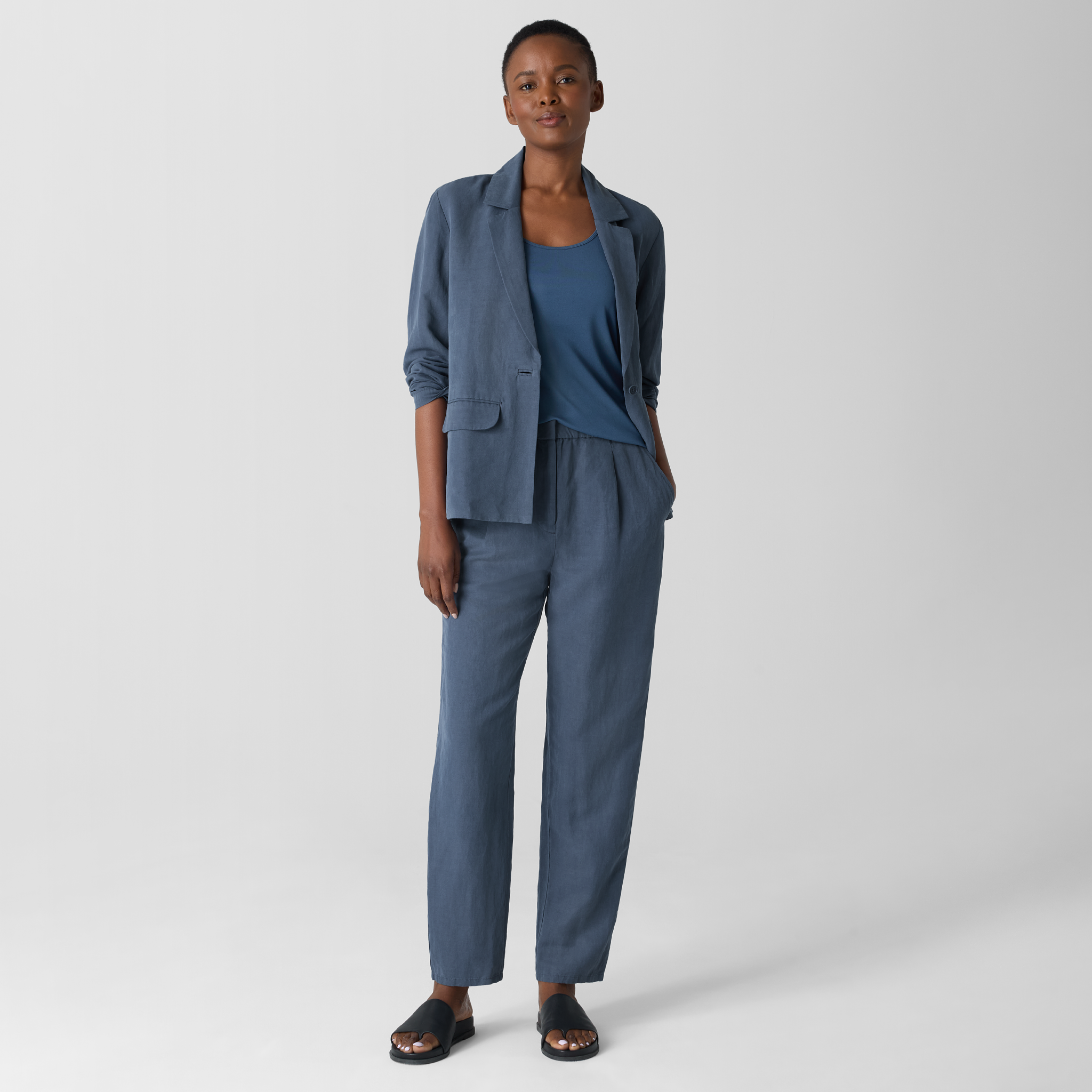
A shirt with actual body to it
The office siren shirt is not a blouse. It is oversized, slightly stiff, usually white or oat, and it works because the fabric has enough structure to stand away from the body. Half-tucked, sleeves pushed up, collar doing the talking. In a soft synthetic that same shirt collapses onto you and the entire effect is gone.
Linen and hemp are the two fibers that give you that. Hemp in particular is worth knowing about: it is stiffer than linen when new, softens with every wash without going slack, and is one of the least demanding fibers there is to grow. The trade is that both crease, and you have to decide you like that. The look is built on a rumple that reads as confidence rather than carelessness, which is a distinction plastic cannot make for you.


The blazer, and what to layer under it
The blazer is where the synthetic tax is highest, because a tailored jacket has two chances to be plastic: the shell and the lining. A linen shell with a polyester lining is still a polyester jacket from the perspective of your arms. The versions worth buying are honest all the way through, and they are the ones that keep working in a warm room.
Under it, a fine knit rather than another shirt is the quieter move. Organic cotton for the shoulder season, alpaca once the building turns the heating on. Alpaca fibers are hollow, so they trap more air than wool at the same weight, which is how a thin knit stays warm without adding bulk under a jacket.


Workwear is the category where fiber content is hardest to find and matters most, and it is worth being precise about why.
It matters most because of contact time. This is ten hours a day, five days a week, on a body that is warm and largely still, in a building with recycled air. Whatever the garment is made of, it has the longest and most repetitive contact with your skin of anything in your wardrobe except what you sleep in.
It is hardest to find because tailoring hides its own composition. A jacket has a shell, a lining, an interfacing and a thread, and the label usually only tells you about the first one. That is not a conspiracy, it is just how garment labelling works, and it is the reason a piece can be sold as linen and still be substantially plastic.
What we will not do is tell you that a polyester blazer is dangerous to wear. There is no good evidence for that and you should be suspicious of anyone who says it. What is true and uncontested is narrower: polyester is a plastic fiber, it does not absorb moisture, it sheds microplastic fibers in the wash, and it does not breathe in a warm room. Toxome scores what a garment is made of, and in a category this opaque, simply being told is most of the value.
Sharp lines, real cloth, and nothing plastic under the jacket. You can shop the office edit, every piece scored by Toxome on its published composition, and build the look out of fabric that survives the day.
Sources
- Toxome. Linen: the fiber guide.
- Toxome. Hemp: the fiber guide.
- Toxome. Polyester: what the fiber is and how it scores.
pins Toxome in your Google results, so our reporting shows up first when you search fabrics and brands.