Linen scores 94 out of 100 for wearer health on Toxome's fiber scale, where 100 is cleanest. That puts it in the safest band to wear. Linen is flax that breathes, runs cool, and softens with every wash. The score rates the fiber, not the finished garment. Mills add dyes and finishes later, so check the label for those.
What is linen?
Linen is spun from the stalk of the flax plant, not a fluffy boll like cotton. The Romans called it linum usitatissimum, most useful flax, and people have worn it for something like 30,000 years. It is one of the oldest, and one of the cleanest, fabrics we know how to make.
Flax was spun into thread before the wheel existed. The Egyptians wrapped pharaohs in it and treated the finest linen as a luxury. The best of it still comes from European flax and, historically, the Nile.
From a field of flowers to thread
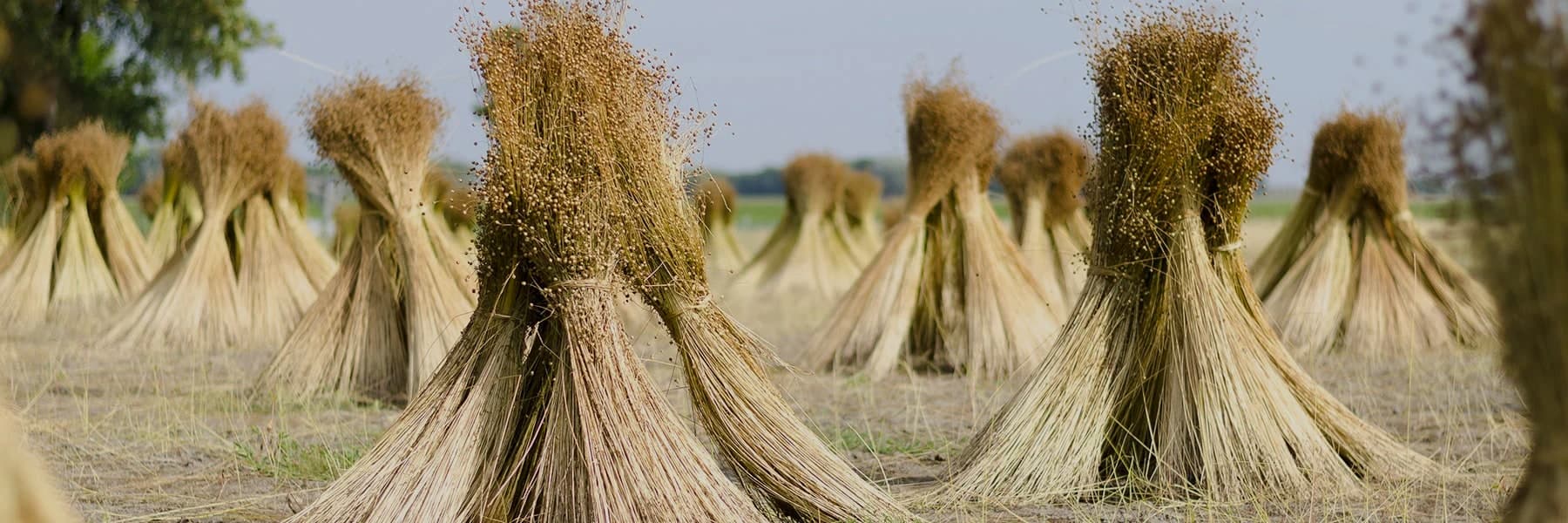
A cool-climate crop that needs little irrigation and few sprays.
Moisture and natural bacteria loosen the woody core from the fiber.
The stalk is crushed and beaten so the woody bits fall away.
Combs pull the long line fibers straight and sort out the short tow.
Spun wet for smooth thread, or dry for the slubbier hand.
Whatever your skin meets was added at the dye and finish, not the field.
Flax grows in cool, damp weather in about 100 days, on little water and few pesticides. The plant is pulled up by the roots, not cut, to keep the fibers long, because the longer the fiber, the finer the cloth. That is why raw linen is one of the cleanest things you can put on your skin.
The best linen is still hand-harvested. Getting the fiber out is slow and mostly mechanical: retting lets dew and bacteria rot away the glue that binds the fiber to the woody stalk, and dew-retting out in a field is the cleanest, least polluting way to do it. Then the stalks are broken, scutched, and combed until only the long, lustrous fibers are left, then spun and woven.
No chemical bath required, and undyed linen breaks down in soil in a few weeks. Whatever risk linen carries is added later, at the finishing stage.
Not all linen is the same
Linen on a label covers a wide range, and the grade of the fiber is what separates the good from the forgettable. The long, combed fibers, called line, make smooth, fine cloth. The short leftovers, tow, make the coarser, cheaper stuff. The longest, finest flax comes from a handful of places, and a provenance mark is a quality signal, not a health promise.
Is linen safe to wear?
The flax fiber itself is biologically inert. It is plant cellulose, and lab tests that check whether a material harms living cells find flax safe against skin. What linen does for your body comes down to moisture and heat, not any special chemistry: its pectin structure pulls sweat off your skin and lets it evaporate fast, so you skip the damp cling that irritates skin and gives bacteria something to grow on.
The health question with a linen garment is the finish, not the fiber. Words like wrinkle-free, easy-care, and anti-static usually mean a formaldehyde treatment was added, a chemical that can cause cancer and irritate skin, sitting on a fiber that never needed it.
The share of its own dry weight the fiber itself absorbs as water vapor, then releases into the air.
A fiber that can hold and release moisture is a fiber that feels dry against the skin. Polyester holds almost none, which is why a synthetic top feels clammy in the heat and linen does not. Figures are the standard reference values for each fiber at 20°C and 65% humidity, not a measurement of any one garment.
- Breathes and wicks. Flax's pectin structure pulls sweat off your skin and lets it evaporate fast, so you skip the damp cling that irritates skin and feeds bacteria.
- Runs cool. Thermoregulating, so less heat and sweat sit trapped against your body.
- Softer with every wash. Smooth and low-lint once broken in. Coarse, brand-new linen can feel stiff, so wash it before wearing on sensitive skin.
- A cleaner surface against skin. Flax resists dust mites and mold, and dries too fast for much bacteria or odor to build up. Its antibacterial reputation is mostly that; the direct evidence is modest.
Linen starts from a clean plant fiber, so its hazard base is low. From there we subtract for the finishes and dyes we can detect. A certified, undyed linen sits near the very top of the scale, which is how it lands at 94. See the full method.
Doing this check on every product page yourself is the tedious part. The Toxome Chrome extension reads the composition for you while you shop, so you see whether something is linen (and what else is in it) before you buy, not after it arrives.
How linen affects the planet
Linen's environmental case is quiet but real. Most of it is European flax grown on rainfall alone, so a kilo of fiber takes a small fraction of the water cotton demands, and the plant needs few pesticides.
Its weak spot is carbon, and the honest answer is that the number swings widely. Studies land anywhere from about half a kilo to well over two per kilo of fiber, driven mostly by how heavily the field is fertilized. Undyed linen then breaks down in soil in weeks to months.
Mostly rain-fed European flax, grown with no irrigation.
The number swings mainly with how much fertilizer the farm uses.
Undyed linen breaks down in weeks to months.
A plant fiber, so it sheds no plastic.
Environmental figures are separate from the health score above, which reflects wearer health only. Numbers are per kilogram of finished fiber and rounded; see sources.
How to care for linen
Shop Linen


Linen, answered
Pure linen is not. The flax fiber itself is safe against skin. The risk comes from what gets added later: wrinkle-free and easy-care finishes (often formaldehyde) and cheap azo dyes. Choose OEKO-TEX Standard 100 or GOTS certified linen and you avoid almost all of it.
Mostly, yes. Linen is smooth, low-lint, and breathable, which tends to suit sensitive skin and eczema. An undyed, certified linen with no performance finish is about as gentle as fabric gets.
A little on the first wash if it was not pre-shrunk. Wash cool (30°C or below) and air dry, and it holds its shape. High heat in the dryer is what shrinks it.
For wearer health and longevity, usually. Linen scores 94 to conventional cotton's 84, uses far less water, and lasts for decades. Cotton is softer on day one; linen gets softer with every wash.
- Is Linen Fabric Toxic? The Science Behind This Natural Textile · Dal The Label
- What Does Oeko-Tex Certified Mean? · George Street Linen
- OEKO-TEX STANDARD 100 Factsheet · OEKO-TEX
- Bacterial adhesion and biofilm formation on linen fabrics · Industrial Crops and Products
- Evaluation of Antibacterial Activity of Flax Fibers Against Staphylococcus aureus · Fibres & Textiles in Eastern Europe
- Best Fabrics for Sensitive Skin · Healthline
- Oldest-known fibers discovered · Harvard Gazette
- European Flax certification and cultivation · Alliance for European Flax-Linen and Hemp
The health score reflects wearer health only and mirrors the Toxome app. This guide is educational and is not medical advice.