Hemp scores 94 out of 100 for wearer health on Toxome's fiber scale, where 100 is cleanest. That puts it in the safest band to wear. Hemp is a durable plant fiber grown with little water and no need for pesticides. The score rates the fiber, not the finished garment. Mills add dyes and finishes later, so check the label for those.
What is hemp?
Hemp is a bast fiber, cut from the woody stalk of the cannabis plant, the same fiber family as flax and ramie. It is one of the least demanding crops in agriculture, and the raw fiber is strong, breathable, and low in residue. What happens between the stalk and the soft tee you buy is where the chemistry hides.
The word canvas comes from cannabis: for centuries hemp was the fiber behind sails and rope, because it resists rot in salt water better than almost anything else. Humans have spun it for over 8,000 years. It only returned to US fields recently, after the 2018 Farm Bill removed hemp (defined as cannabis with less than 0.3 percent THC) from the controlled-substances list.
How hemp is made
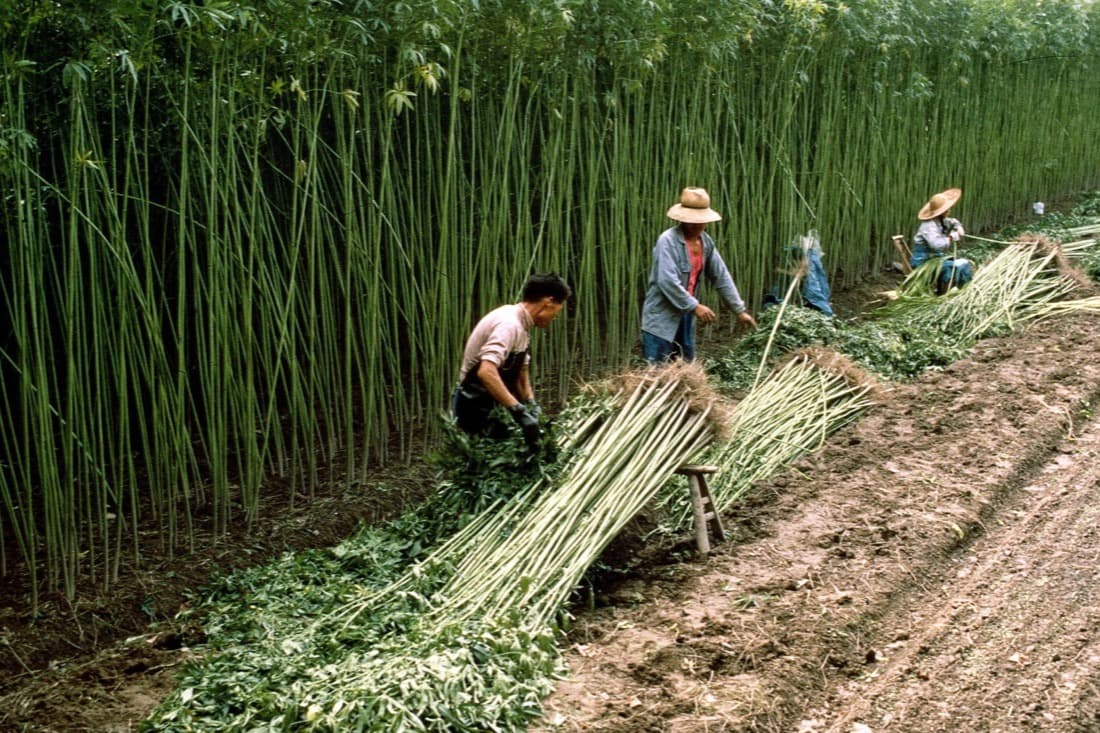
Dense growth in about 100 days shades out weeds, so fewer sprays are needed.
Moisture and bacteria loosen the woody core, the same idea as flax.
The stalk is broken and combed apart mechanically to free the fiber.
The fork that decides your garment: enzymes and machines, or a caustic soda bath.
Cottonized fiber is fine enough to spin on cotton machinery.
Softness is a clue, not a guarantee. Cleanly softened hemp starts near zero.
Hemp earns its low-input reputation. It grows dense in as little as 100 days, and its tall canopy shades out weeds on its own, so it needs fewer herbicides and pesticides than corn or soy, and less water. A field of it can be grown with little sprayed on it.
Freeing the fiber uses the same idea as linen: retting lets moisture and natural bacteria loosen the woody core, then the stalk is broken and combed apart mechanically, a step called decortication. Fiber pulled out this way stays strong, but it also stays stiff, because raw hemp still holds 8 to 10 percent lignin, the rigid glue that makes a stalk a stalk.
Here is the fork that decides your garment. To feel as soft as cotton, hemp is cottonized: its lignin is stripped down toward 0.2 percent so the fiber is fine enough to spin like cotton. The cheapest, most common way to do that is a hot alkali bath (caustic soda), which is efficient but weakens the fiber and leaves chemistry that has to be rinsed out. The cleaner routes soften mechanically or with enzymes instead. Both keep the fiber's low-residue promise intact.
So the softness in a hemp piece is a clue, not a guarantee. A mechanically or enzyme-processed hemp starts with almost nothing to wash off. A chemically cottonized one carries whatever the alkali bath, and then the dyes and finishes, left behind.
Not all hemp is the same
Hemp does not vary by region the way linen does. What varies, and what decides how it feels and what it carries, is how it was processed from stalk to thread.
Is hemp safe to wear?
The hemp fiber itself is a low-chemical plant fiber. It breathes, it does not cling to the compounds that bother reactive skin, and it softens with wear. A fiber being natural does not protect you on its own, but hemp starts from an unusually clean base.
Two things add risk after the field. The first is how it was softened: chemically cottonized hemp goes through a caustic alkali bath that has to be fully rinsed, and residue left on a cheaply made piece sits against your skin. The second is standard finishing chemistry, azo dyes that can break down into compounds linked to cancer and cause rashes, and formaldehyde resins added to stop wrinkling, which can irritate skin. A cheaply dyed hemp piece is not automatically cleaner than any other fabric.
The share of its own dry weight the fiber itself absorbs as water vapor, then releases into the air.
A fiber that can hold and release moisture is a fiber that feels dry against the skin. Polyester holds almost none, which is why a synthetic top feels clammy in the heat and hemp does not. Figures are the standard reference values for each fiber at 20°C and 65% humidity, not a measurement of any one garment.
- Grows on almost nothing Fast, dense, and self-shading, hemp needs fewer pesticides and less water than most crops, so an undyed piece starts with little to wash off.
- Breathes and moves air Loosely spun and airy, hemp lets heat and moisture pass through instead of trapping them against skin.
- Softens with wear Even without chemical cottonization, hemp breaks in and gets kinder to skin the more you wash and wear it.
- Resists mildew and odor Like its cousin flax, hemp is often described as resistant to mold and odor-causing bacteria, though the direct evidence is thinner than the reputation.

Hemp starts as a low-pesticide, low-processing plant fiber, so its hazard base sits near flax and linen. From there we subtract for the dyes and finishes we can detect, plus the risk that a chemically cottonized piece was not fully rinsed. A certified, undyed, cleanly processed piece sits near the top of the scale, which is how it lands at 94. See the full method.
Doing this check on every product page yourself is the tedious part. The Toxome Chrome extension reads the composition for you while you shop, so you see whether something is hemp (and what else is in it) before you buy, not after it arrives.
How hemp affects the planet
Hemp earns its “miracle plant” reputation in the field. It reaches harvest in about 100 days, needs little irrigation because its deep roots reach water most crops cannot, and grows densely enough to shade out weeds without heavy herbicide use. The same acre yields far more usable fiber than cotton.
The honest caveat is processing. Turning the stalk into a soft fiber can be done mechanically, which keeps it clean, or with chemical softening, which does not. And like any fabric, an undyed hemp with a low-impact finish is far gentler on the planet than a heavily dyed one.
Mostly rain-fed. Hemp’s deep roots pull moisture from soil cotton cannot reach.
The growing plant absorbs roughly 1.6 tonnes of CO₂ per tonne of fiber, offsetting most of what processing emits.
Undyed hemp breaks down in soil. Dyes and coatings are what slow it down.
Hemp is a plant fiber, so it does not shed plastic into water or air.
Environmental figures are separate from the health score above, which reflects wearer health only. Numbers are per kilogram of finished fiber and rounded; see sources.
How to care for hemp
Shop Hemp


Hemp, answered
No. The hemp fiber itself is a low-chemical plant fiber that needs few pesticides to grow and no chemical bath to free. Your real exposure comes from how it was softened and finished: a chemically cottonized, cheaply dyed piece can carry alkali residue, azo dyes, and formaldehyde like any other fabric. Look for OEKO-TEX Standard 100 and mechanically or enzyme-processed hemp.
No. Industrial hemp is defined as cannabis with less than 0.3 percent THC, and the retting, decortication, and washing that turn stalk into fiber strip out cannabinoids anyway. Wearing hemp has no psychoactive effect.
Softness comes from processing, not the plant. Raw, minimally processed hemp starts coarse and breaks in over time. Soft hemp has usually been cottonized, its stiff lignin stripped out, sometimes with enzymes (clean) and sometimes with a caustic chemical bath (needs thorough rinsing). Feel matters, but the certification tells you which route was taken.
For wearer health and growing impact, generally yes. Hemp needs far fewer pesticides and less water than conventional cotton and scores 94 to its 84. Organic cotton narrows the gap on residue, but hemp is still the lower-input crop to grow.
- What chemicals are in Textiles and the Health Implications · Allergy Standards
- Is Formaldehyde in Clothing Dangerous? · Kherkher Garcia
- OEKO-TEX STANDARD 100 Factsheet · OEKO-TEX
- A comparative life cycle assessment of textile fiber production processes: Hemp versus cotton · Sustainable Manufacturing and Service Economics (ScienceDirect)
- Comparative study of water requirements and water footprints of fibre crops hemp and cotton · ResearchGate
- Industrial Hemp: A review of economic potential, carbon sequestration and bioremediation · Portland State University
The health score reflects wearer health only and mirrors the Toxome app. This guide is educational and is not medical advice.