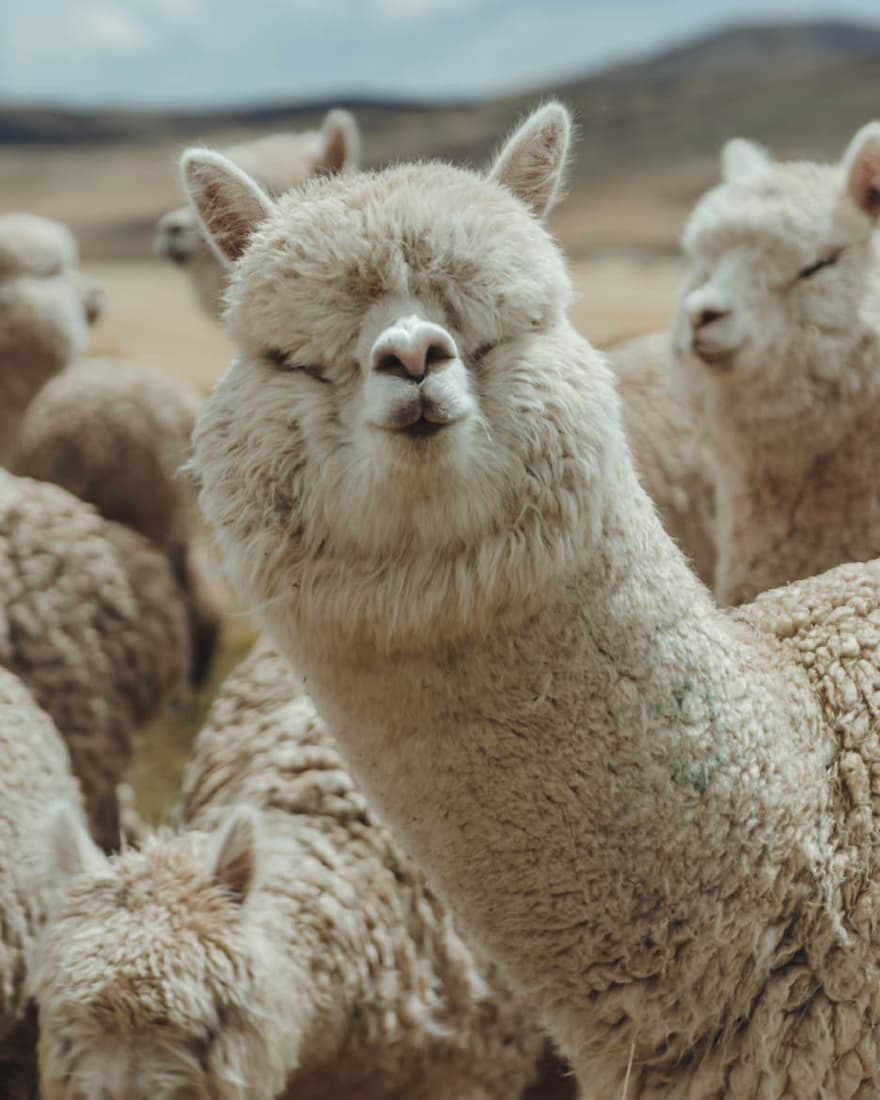
Alpaca scores 92 out of 100 for wearer health on Toxome's fiber scale, where 100 is cleanest. That puts it in the safest band to wear, and no animal fiber scores higher here. Alpaca carries no lanolin and has a smoother surface than sheep wool, so it often suits skin that finds wool itchy. The score covers the fiber, not the finish. Mills add dyes and shrink-resist treatments afterwards, so check the label for those.
What is alpaca?
Alpaca is a camelid, a cousin of the llama and the vicuna, not a sheep, which is why its fleece behaves so differently against skin. It grows in more than 20 natural colors, from white through fawn and brown to near-black, so a large share of alpaca reaches you with no dye on it at all.
Alpacas have been herded across the high Andes for thousands of years, and the Inca kept the finest, softest fleece from young animals for royalty. Herds still live above 3,500 meters on thin grass, and most are shorn once a year by hand.
How alpaca is made
Shorn once a year in spring, closer to a haircut than anything harmful.
A few pounds per animal: fine undercoat mixed with coarse guard hairs.
Only 1 to 3 percent grease, so it skips the aggressive scouring wool needs.
A mechanical sort pulls the coarse hairs out by diameter. No chemistry.
Natural-color fleeces often skip the dye bath entirely.
Lanolin-free from the start, and free of the hairs that cause most wool itch.
Alpacas are shorn once a year, usually in spring, in a process closer to a haircut than anything harmful. Each animal gives a few pounds of fleece: a fine, soft undercoat mixed through with coarser guard hairs.
The processing stays light because the fleece is nearly grease-free. Huacaya alpaca carries only about 1 to 3 percent grease, against 10 to 20 percent lanolin in sheep wool, so it skips the aggressive scouring wool needs to strip that grease out. The fleece is skirted, gently washed, and, for the finer grades, dehaired: a mechanical sort that pulls the coarse guard hairs from the soft undercoat by diameter, no chemistry involved.
That leaves the fiber's added risk almost entirely in dyeing and finishing, and even that is often skipped on the natural-color fleeces. Alpaca starts lanolin-free and, once well dehaired, free of the thick hairs that cause most of the itch people blame on wool.
Not all alpaca is the same
Alpaca is graded almost entirely by micron count, the fiber's width in millionths of a meter. Royal alpaca runs around 19 microns or finer, the softest and rarest grade, often from young animals. Baby alpaca is a grade name, not an age, sitting around 18 to 22 microns. Standard adult alpaca runs coarser, 23 to 27 microns and up, fine for coats and blankets but rougher worn against bare skin.
Is alpaca safe to wear?
Alpaca tends to sit easier on reactive skin than sheep wool, for two reasons you can feel. It is close to grease-free, roughly 1 to 3 percent versus wool's 10 to 20 percent lanolin, so the lanolin-grease reaction behind most true wool problems has nothing to grab onto. Its individual fibers are also smoother and rounder than wool's, so they press on the skin's nerve endings less.
Most of what gets called a wool or alpaca allergy is not an immune reaction. It is prickle, the physical feeling of stiff, thick fiber ends poking your skin. A coarse, poorly dehaired alpaca can still prickle no matter how lanolin-free it is, so fineness and dehairing quality decide comfort more than the animal does.
The share of its own dry weight the fiber itself absorbs as water vapor, then releases into the air.
A fiber that can hold and release moisture is a fiber that feels dry against the skin. Polyester holds almost none, which is why a synthetic top feels clammy in the heat and alpaca does not. Figures are the standard reference values for each fiber at 20°C and 65% humidity, not a measurement of any one garment.
- Nearly grease-free At 1 to 3 percent grease versus 10 to 20 percent lanolin in sheep wool, alpaca skips the waxy coating behind most true wool-grease reactions.
- Smoother fiber surface Rounder, smoother fibers press on the skin's nerve endings less than wool's, so well-graded alpaca feels less prickly at the same thickness.
- Warm for its weight The fiber is semi-hollow, trapping air along its length, so it insulates well while staying lighter than sheep wool.
- Natural color, no dye Grows in more than 20 shades, so a lot of alpaca reaches you before a dyebath is ever involved.

Alpaca starts from a clean, nearly grease-free animal fiber, so its hazard base runs low before any processing, and the light scouring it needs adds little. A fine, undyed, well-dehaired alpaca sits near the top of the scale; dye and finishing chemistry is what pulls a piece down, not the fleece. See the full method.
Doing this check on every product page yourself is the tedious part. The Toxome Chrome extension reads the composition for you while you shop, so you see whether something is alpaca (and what else is in it) before you buy, not after it arrives.
How to care for alpaca
Shop Alpaca


Alpaca, answered
No. Alpaca is a clean animal protein fiber with almost no grease and no lanolin. Any risk comes from dyes and finishes added after shearing, so OEKO-TEX Standard 100 certified alpaca carries little, and undyed natural-color alpaca carries less.
It tends to be gentler than sheep wool because it is nearly lanolin-free with a smoother fiber surface. The itch some people feel from any animal fiber is usually prickle from thickness, not a true allergy, so fine, well-dehaired alpaca is the most comfortable choice.
Generally, yes. The fiber is semi-hollow, so it traps more air and insulates better ounce for ounce than sheep wool while staying lighter.
For lanolin-sensitive skin, often yes, since alpaca has almost none. Past that, the two are close: comfort comes down to how thin the fiber is and how well it was processed.
- Is Alpaca Wool Hypoallergenic or Lanolin-Free? · Yanantin Alpaca
- Alpaca vs Wool: Which Is Better for Sensitive Skin? · Suri Performance Alpaca Socks
- Is Alpaca Wool Itchy? Why It's Softer Than Sheep's Wool · Loom & Fiber
The health score reflects wearer health only and mirrors the Toxome app. This guide is educational and is not medical advice.