What are the PFAS apparel regulations for 2027? On January 1, California's limit on total organic fluorine in clothing drops from 100 ppm to 50 ppm, and Washington and Rhode Island begin banning clothing made with intentionally added PFAS. Colorado, Connecticut, New Mexico and New Jersey follow in 2028, and the EU's limit on one PFAS, PFHxA, has applied to clothing since October 10, 2026.
PFAS, short for per- and polyfluoroalkyl substances, are the "forever chemicals" behind most water-, stain- and wrinkle-resistant finishes. They don't break down, which is why lawmakers are writing them out of clothing one state at a time.
For a brand, the question has moved on from whether a finish works. Now it's whether you can prove what's in the garment when a buyer, a regulator or a customer asks.
PFAS rules for clothing
4 states with a ban in force, 6 more coming
California
Ban in force · since Jan 1, 2025- Ban on added PFAS in textiles, or 100 ppm organic fluorine. Certificate of compliance required.
- Organic fluorine limit drops to 50 ppm.
- Severe wet gear loses its exemption.
- Ban in force
- Ban coming
- Reporting or later
- No clothing rule yet
| Where | Status on Today | Key dates |
|---|---|---|
| California | Ban in force | Jan 1, 2025: Ban on added PFAS in textiles, or 100 ppm organic fluorine. Certificate of compliance required. Jan 1, 2027: Organic fluorine limit drops to 50 ppm. Jan 1, 2028: Severe wet gear loses its exemption. |
| New York | Ban in force | Jan 1, 2025: Ban on added PFAS in apparel, including underwear and uniforms. Jan 1, 2028: Severe wet gear joins the ban. A numeric limit is still to be set. |
| Maine | Ban in force | Jan 1, 2026: Ban on added PFAS in textile articles, including apparel. Jan 1, 2029: Severe wet gear needs a "Made with PFAS chemicals" disclosure. Jan 1, 2032: Ban on added PFAS in all products. |
| Vermont | Ban in force | Jan 1, 2026: Ban on added PFAS in textiles and apparel, or 100 ppm organic fluorine. Jul 1, 2027: Organic fluorine limit drops to 50 ppm. Jul 1, 2028: Outdoor and severe wet apparel come into scope. |
| Washington | Ban coming | Jan 1, 2027: Ban on added PFAS in apparel and accessories made from this date. Total fluorine over 50 ppm is presumed added. |
| Rhode Island | Ban coming | Jan 1, 2027: Ban on added PFAS in textile articles. Jan 1, 2029: Severe wet gear needs a disclosure. |
| Colorado | Ban coming | Jan 1, 2025: Severe wet gear sold with PFAS must say "Made with PFAS chemicals." Jan 1, 2028: Ban on added PFAS in textile articles and apparel. |
| Connecticut | Ban coming | Jul 1, 2026: Apparel with added PFAS needs notice to the state and a label. Jan 1, 2028: Ban on added PFAS in apparel. |
| New Mexico | Ban coming | Jan 1, 2027: Makers of products with added PFAS must report. The labeling rule is on hold in court. Jan 1, 2028: Ban on added PFAS in textiles. |
| New Jersey | Ban coming | Aug 27, 2028: Ban on added PFAS in apparel, including activewear, swim and footwear. |
| Minnesota | Reporting or later | Sep 15, 2026: Reports due for products with added PFAS. The 2025 ban covers textile furnishings, not clothing. Jan 1, 2032: Ban on added PFAS in all products, including clothing. |
| Illinois | Reporting or later | Jan 1, 2032: Ban on added PFAS in intimate apparel. |
| European Union | Ban in force | Oct 10, 2026: Consumer clothing and footwear: PFHxA under 25 ppb. Oct 10, 2027: Other consumer textiles follow. A ban on all PFAS is still being decided; as proposed, clothing would get 18 months. |
| France | Ban in force | Jan 1, 2026: Ban on PFAS in consumer clothing and footwear. Limits: 25 ppb per PFAS, 50 ppm including polymers. Jan 1, 2030: Ban extends to all textiles. |
| Denmark | Ban in force | Jul 1, 2026: Ban on clothing and footwear with 50 mg/kg total fluorine or more, including online orders from abroad. |
Dates and limits from each state's statute or rule, linked below. New Jersey's date comes from a Lowenstein Sandler summary of P.L. 2026, c. 76. This is a guide for planning, not legal advice.
Which states ban PFAS in clothing?
California, New York, Maine and Vermont already ban intentionally added PFAS in clothing. Washington and Rhode Island join on January 1, 2027, and four more states follow in 2028.
Already in force
California has banned regulated PFAS in new textiles since January 1, 2025. "Regulated" means added on purpose, or present at 100 ppm or more of total organic fluorine. That covers apparel, bags, bedding and towels.
New York banned intentionally added PFAS in apparel the same day, including underwear, uniforms and diapers. Maine followed on January 1, 2026 for textile articles. Vermont did the same for textiles, apparel and footwear, with a 100 ppm organic fluorine line.
One common mix-up: Minnesota's 2025 ban covers textile furnishings, not clothing. Clothing there falls under reporting rules now and a ban on all products with added PFAS in 2032.
Starting in 2027
Washington bans intentionally added PFAS in apparel and accessories made on or after January 1, 2027. The state treats total fluorine above 50 ppm as a sign that PFAS were added, and a brand has to rebut that with evidence. Fines run up to $5,000 per violation.
Rhode Island bans textile articles with added PFAS on the same date. Vermont's limit drops from 100 ppm to 50 ppm on July 1, 2027.
Starting in 2028
Colorado, Connecticut and New Mexico start their clothing bans on January 1, 2028. California and New York end their exemption for "severe wet conditions" gear the same day. That's the expert-grade outerwear for offshore sailing and mountaineering that has been allowed to carry a "Made with PFAS chemicals" label. New Jersey's apparel ban starts August 27, 2028.
Is PFAS banned in California?
In clothing, yes. Since January 1, 2025, California has banned intentionally added PFAS in textiles, plus any textile with 100 ppm or more of total organic fluorine. On January 1, 2027, that number drops to 50 ppm.
What 50 ppm means
Total organic fluorine is a screen. The lab burns a small piece of fabric and measures the fluorine left behind, minus the inorganic kind found in minerals. Since every PFAS contains fluorine, the number shows how much PFAS chemistry is in the fabric, without naming each chemical.
Fifty ppm is 50 milligrams of organic fluorine per kilogram of fabric, or 0.005% by weight. In a 2022 study in Environmental Science & Technology, researchers at Silent Spring Institute screened 93 children's products. Twenty-eight came in above 100 ppm, and the highest, a stain-resistant school uniform shirt, reached 3,660 ppm. Of the products with no water- or stain-resistance claim, six of the seven with any detectable fluorine came in under 50 ppm.
So the 50 ppm line catches a deliberate fluorinated finish. It also catches one a supplier added without telling you.
What the certificate has to say
California requires every manufacturer to give sellers a signed certificate of compliance stating that the product meets the law. A retailer that relied on it in good faith is protected. The certificate carries the weight, so the evidence behind it matters.
Does the EU restrict PFAS in apparel yet?
Yes, in part. Since October 10, 2026, clothing and footwear sold to EU consumers must contain less than 25 parts per billion of PFHxA and its salts, and less than 1,000 ppb of related substances, under Regulation (EU) 2024/2462. Rain jackets are included. Other consumer textiles, like bedding, follow on October 10, 2027.
The broader restriction
A proposal to restrict all PFAS across the EU is still moving. The European Chemicals Agency's risk committee adopted its opinion in March 2026, and the socio-economic committee is due to finish by the end of 2026. A Commission decision is expected in 2027. As proposed, consumer clothing gets no exemption: a ban 18 months after the rule takes effect.
France and Denmark went first
France banned PFAS in consumer clothing and footwear on January 1, 2026, and in all textiles from 2030. Its thresholds are 25 ppb for any single PFAS, 250 ppb for the total, and 50 ppm including polymers. Denmark's ban started July 1, 2026, at 50 milligrams of total fluorine per kilogram in any part of the garment. It applies to online orders shipped in from abroad, too.
What is a PFAS certificate of compliance?
A PFAS certificate of compliance is a signed statement from the manufacturer that a product meets a state's PFAS law. California requires one for every textile sold. New York tells sellers to keep one on file and show it on request, and Vermont, Rhode Island and Connecticut can each demand one.
A signature isn't evidence
A certificate is a promise. Most brands sign theirs based on what a supplier says about a finish, a dye house or a trim, and on a restricted substances list (RSL) the factory agreed to. An RSL is your own list of chemicals suppliers can't use. Many now include PFAS, but it's an agreement between you and your factories, not proof of what reached the shelf.
When a regulator, a retail buyer or a lawyer asks what's behind the signature, a test report of the finished product is the strongest answer you can give.
For brands
Put a lab result behind your certificate.
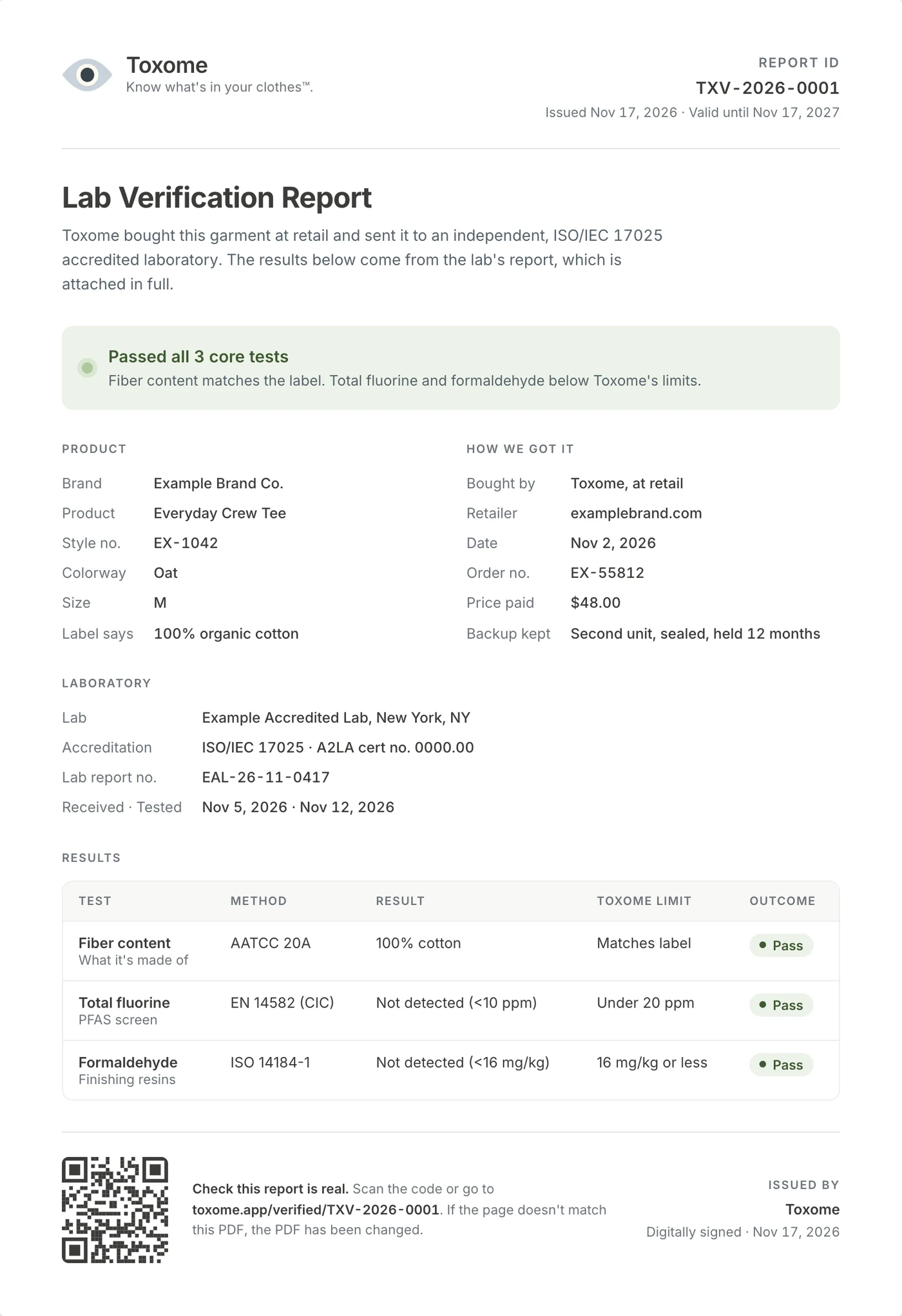
Toxome Verified buys your product at retail and sends it to an independent accredited lab for a PFAS screen, formaldehyde and fiber content. Products that pass carry the Toxome Verified seal, with every result on a public record.
See how Toxome Verified worksHow can brands test for PFAS in clothing before shipping?
Brands test PFAS in clothing two ways: a total organic fluorine screen, which shows whether PFAS chemistry is present at all, and targeted tests, which name specific chemicals like PFHxA. California, Vermont and Washington write their limits around the screen. The EU's PFHxA limit needs a targeted test.
Screen first, then target
A fluorine screen is fast and catches what a targeted test can miss, including fluorinated polymers bonded into the fiber. A targeted test, run by liquid chromatography with mass spectrometry, confirms which PFAS are present and in what amount. For EU sales, you need both.
Test what's on the shelf
The most common gap is the sample. A pre-production swatch shows what the mill intended. A finished garment bought off the shelf shows what customers actually wear, after the dye house, the finisher and the trim supplier have all had a turn. Use a lab accredited to ISO/IEC 17025, the international standard for testing labs, and keep the full report.
Where to look first
PFAS shows up where a garment promises to resist something. In a 2022 Toxic-Free Future study, 72% of products marketed as stain- or water-resistant contained PFAS, and none of the products without that claim did. A 2022 study of school uniforms found PFAS in every stain-resistant item it analyzed in detail, including 100% cotton. A natural fiber doesn't rule out a finish.
Start with anything labeled water-repellent, stain-resistant, wrinkle-free or easy-care, plus outerwear, activewear, uniforms and children's clothing. We cover what this looks like for shoppers in our guides to PFAS in leggings and rain jackets without PFAS.
Are PFAS banned in the US?
Not nationally. There's no federal ban on PFAS in clothing, and a federal bill that would add one is still in committee. The rules come from the states.
Federal reporting is still coming
The EPA does require PFAS reporting under the Toxic Substances Control Act. Under its April 2026 rule, the reporting window opens by January 31, 2027 at the latest. As written, it still covers companies that import clothing containing PFAS. The EPA has proposed exempting imported articles but hasn't finalized that, so importers should keep their records ready.
How brands get ahead of PFAS rules
The brands that handle this calmly do three things before a deadline forces them to.
Map every finish
List every water-repellent, stain-resistant and easy-care finish in your line, and ask each supplier for the exact chemistry in writing. The finishes nobody asked about are the ones that show up in a test.
Test finished goods against the strictest line
Plan around 50 ppm, the line California, Vermont, France and Denmark have all landed on. A product that tests well under it works in every market at once, which is simpler than tracking each state's calendar.
Make the proof public
A certificate in a filing cabinet protects you from a regulator. A lab result your customer can open protects you with everyone else. Shoppers searching for clothing without PFAS want a reason to believe a claim, and saying "PFAS-free" without data invites the question you least want to answer. A test result with a report number answers it before anyone asks.
How Toxome Verified works
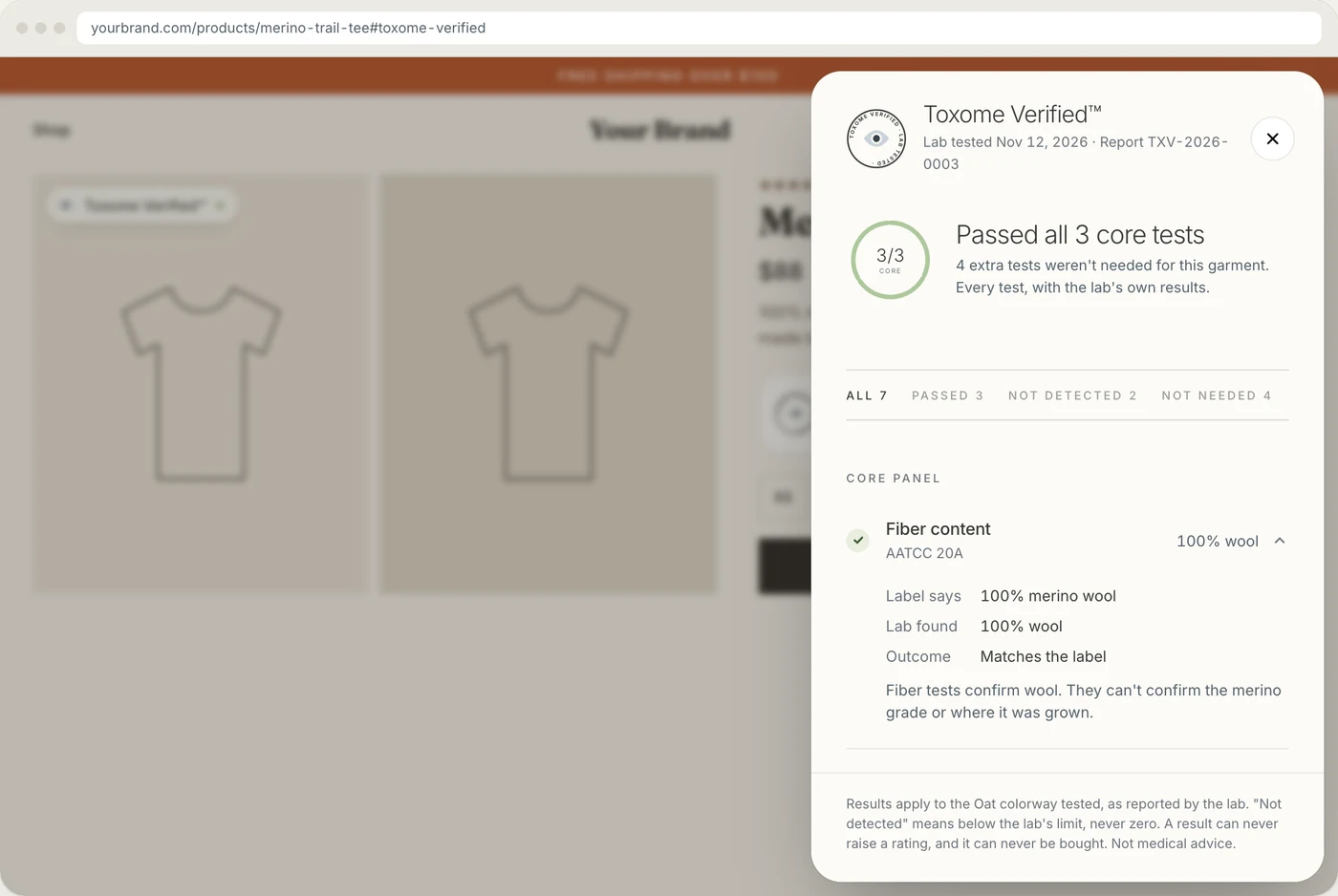
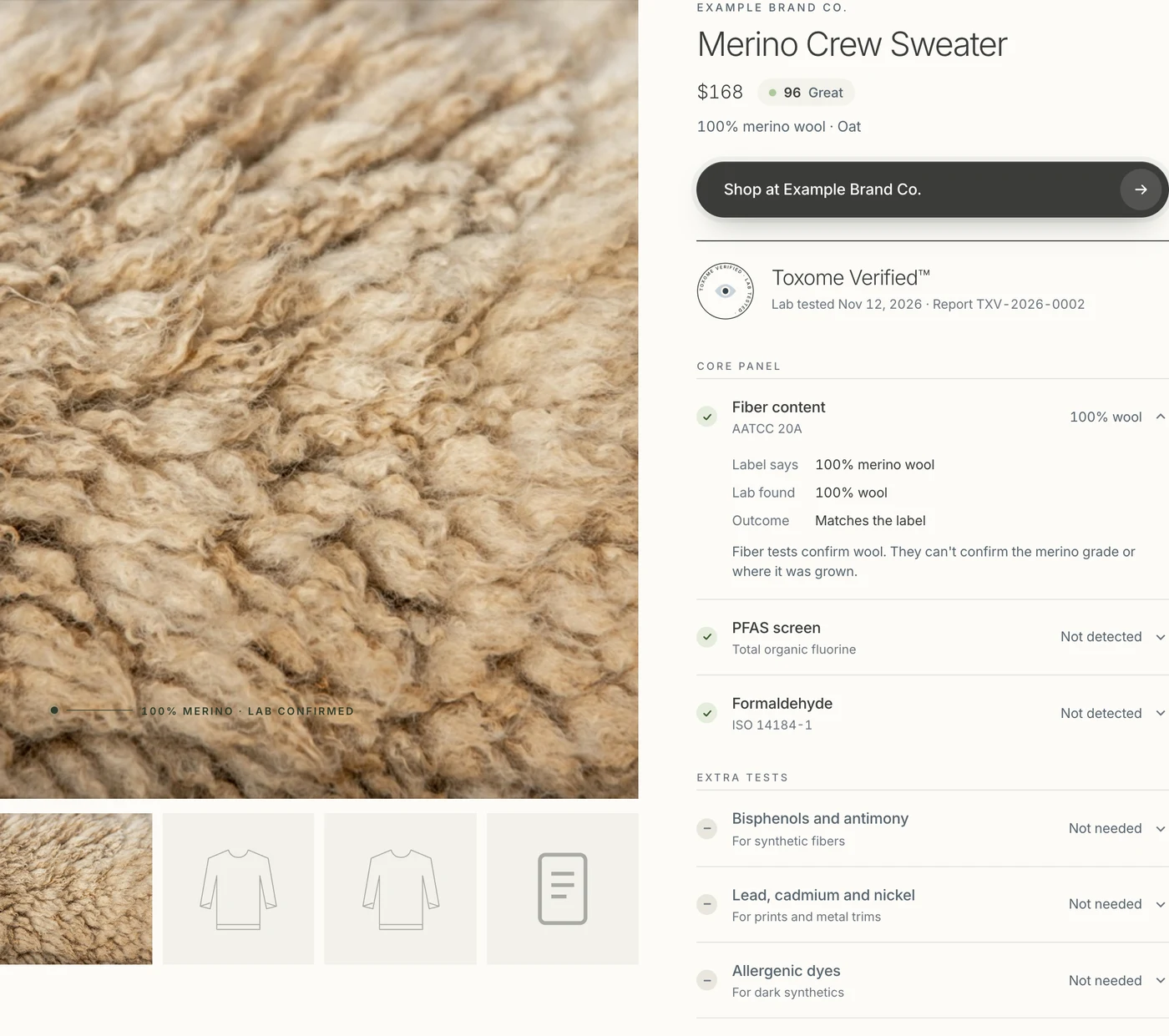
Toxome Verified is our lab-testing program for brands. We buy your product at retail, like any shopper, so the sample is the one your customers get. An independent, ISO/IEC 17025 accredited lab tests it for three things: fiber content against the label, formaldehyde, and total organic fluorine as a PFAS screen.
The PFAS pass line is under 20 ppm of total organic fluorine. That's well below California's and Vermont's 50 ppm lines. Washington and Denmark measure total fluorine, which runs at least as high as organic fluorine, so a result under 20 ppm of organic fluorine doesn't prove those limits on its own. For EU sales, pair it with a targeted PFHxA test.
Products that pass get a public record with the lab's full report, a hang tag with a QR code to that record, and a badge for your product page. Only a passing lab result earns the seal, and it can never be bought.
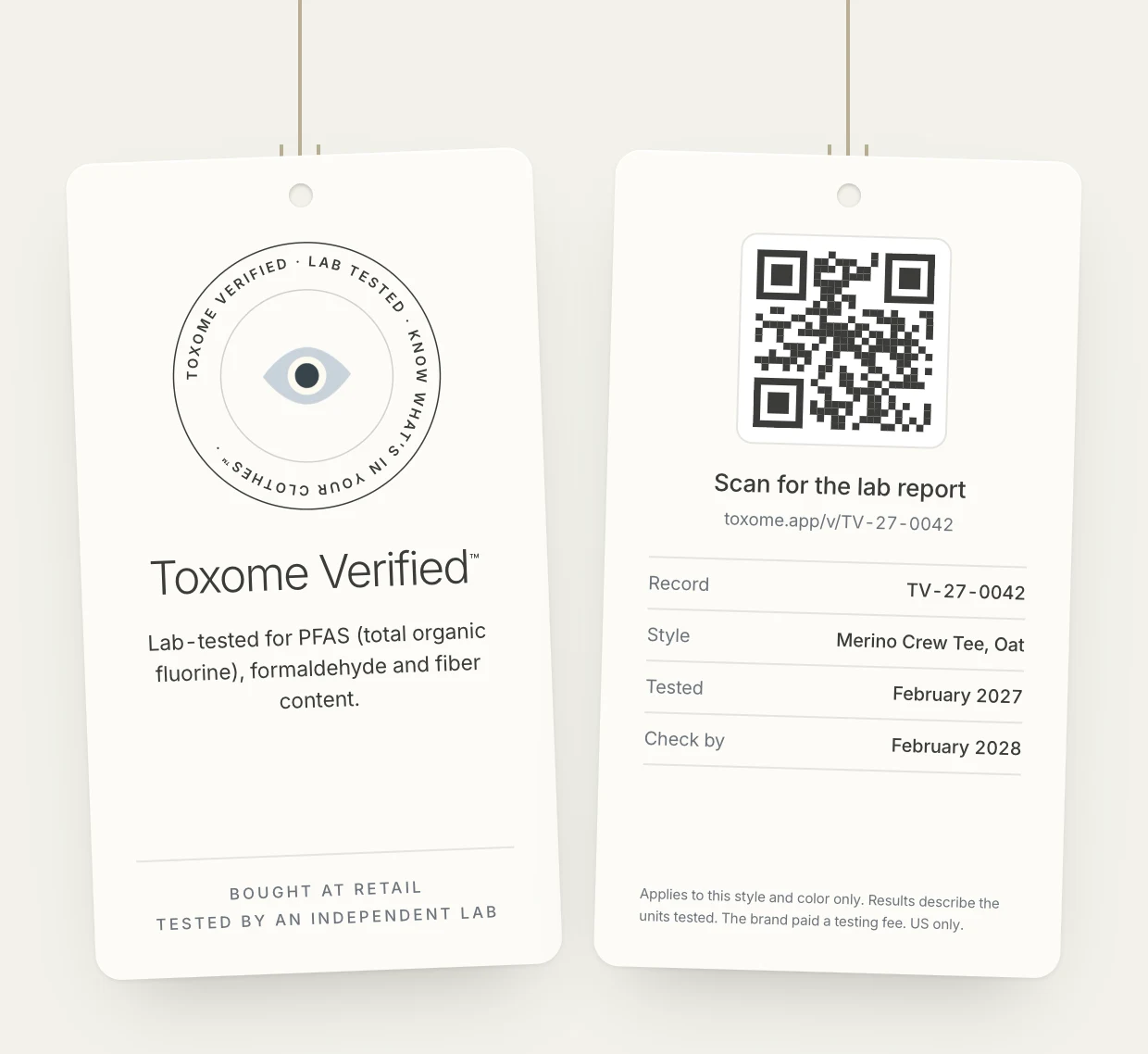
A Toxome Verified result supports your certificate of compliance. It doesn't replace it, and it doesn't make Toxome your compliance counsel. What it does is put an independent, shelf-bought lab result behind the signature, where buyers, regulators and customers can all see it.
Toxome Verified
Get a product tested before January.
Apply with the products you'd like tested and we'll walk you through the panel, timing and pricing. Not ready for a lab test? Brands can get certified for free with the certificates they already hold.
Apply for Toxome VerifiedThe rules will keep tightening, and the EU's broad restriction is still to come. A brand that can show its results now won't be scrambling when it lands.
Frequently asked
California, New York, Maine and Vermont already ban intentionally added PFAS in clothing. Washington and Rhode Island start on January 1, 2027. Colorado, Connecticut and New Mexico follow in 2028, and New Jersey in August 2028.
In clothing and other textiles, yes. Since January 1, 2025, California has banned intentionally added PFAS and total organic fluorine of 100 ppm or more. On January 1, 2027 that limit drops to 50 ppm.
California's PFAS testing threshold is 100 ppm of total organic fluorine today and 50 ppm from January 1, 2027. A textile at or above that level counts as containing regulated PFAS, even if nothing was added on purpose.
Yes, in part. Since October 10, 2026, consumer clothing sold in the EU must stay under 25 ppb of PFHxA. A broader restriction covering all PFAS is still being finalized. France and Denmark have their own national bans.
A PFAS certificate of compliance is a signed statement from the manufacturer that a product meets a state's PFAS law. California requires one for every textile sold, and Vermont, Rhode Island and Connecticut can demand one on request.
Brands test PFAS in clothing with a total organic fluorine screen, which burns a sample and measures the fluorine, plus targeted tests for specific chemicals like PFHxA. Use an ISO/IEC 17025 accredited lab and test what's actually sold, not a pre-production sample.
No. An RSL is a brand's own list of chemicals its suppliers can't use. Many RSLs now include PFAS, but an RSL is a promise between a brand and its factories. State laws and lab results are what regulators check.
Not nationally. There's no federal ban on PFAS in clothing. The rules come from individual states, and the EPA requires PFAS reporting under federal chemical law, with a reporting window opening by January 31, 2027.
Comments
No comments yet.
That didn't go through. Try again.