The 2026 Fall Denim Guide
The silhouettes worth buying this fall, and the one number on the label that decides how long they last.
4 min read

Denim is the one thing in a closet everybody assumes is honest. It is cotton, it is blue, it has been the same object for a hundred and fifty years. You buy a pair without reading the label, because what would the label even say.
It says elastane. Somewhere between one and three percent of almost every pair sold today is a polyurethane-based synthetic spun through the whole garment, and that small number is doing a lot of work. It is why the jeans that fit perfectly in the shop bag out at the knee by March. It is why a pair you loved for two years suddenly has no shape. Stretch is not a finish sitting on the surface of the cloth, it is a second fiber running through every thread of it, and when it fatigues the garment goes with it.
The good news is that the fall silhouettes are on your side. Wide legs, pleated trousers and the barrel jean all want a heavier, drier, rigid cloth, and rigid cloth does not need stretch to work. Here is what to buy, and what the number on the label is actually telling you.
The rigid jean is back
For fifteen years the default jean was a stretch jean, because the default silhouette was skinny and a skinny leg has to give somewhere. That silhouette is over, and the fabric that served it went with it. What replaced it is rigid denim: 100% cotton, no give, heavier in the hand, and stiff for the first month in a way that used to be the whole point.
A rigid pair breaks in rather than wearing out. Cotton fibers soften and mould to you with wear instead of slackening, so the fit you end up with after a season is yours rather than the factory's, and it holds. Every pair here is 100% cotton with nothing spun through it, which is also the cleanest denim there is: no synthetic fiber against the skin, and nothing to shed in the wash.


The wide leg, and what the stretch is costing you
The wide leg is the silhouette of the season and the easiest one to buy well, because a wide leg has no reason to stretch. Nothing about the cut needs to give. Any elastane in a wide-leg jean is there because the mill was already running a stretch denim, not because the garment asked for it.
This is where reading the number pays. The pieces below run from 100% organic cotton up through a 1% elastane wide leg, and the spread is the whole argument: same silhouette, same price bracket, materially different garment in three years. Elastane is a synthetic, it does not breathe, and as our elastane guide sets out, it is the fiber that degrades first and takes the fit with it. One percent is not a health emergency. It is a shelf life.


Barrel legs, and denim that isn't trousers
The barrel jean is the one genuinely new shape of the year: curved through the thigh, tapering in at the ankle, sculptural in a way a straight leg cannot be. It is cut from a lot of cloth, which makes the fiber question louder rather than quieter, and the better versions lean on lyocell rather than elastane to get their drape. Lyocell is regenerated from wood pulp in a closed loop that reuses its solvent, so a cotton-lyocell denim gets softness and fluidity without spinning plastic through the leg.
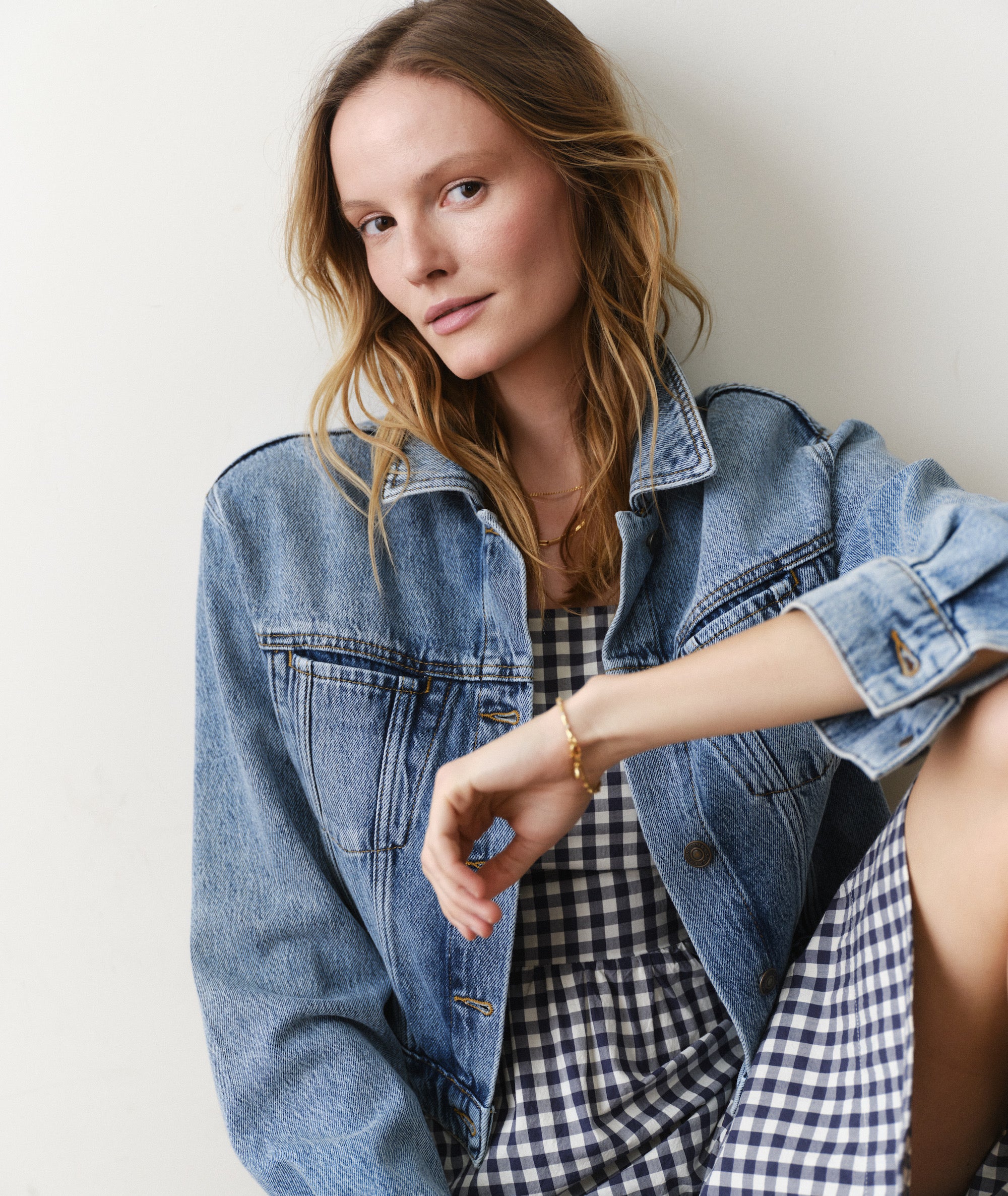
The same logic runs through the rest of the category. A denim jacket, a denim dress, a denim romper: all of them are the same cloth doing a different job, and all of them are worth the same one-line check before you buy. Every piece in this section is scored on its published composition, so the trade-off is visible instead of implied.




Two things about denim are worth stating carefully, because the category attracts more scare copy than almost any other.
The first is the elastane itself. It is a polyurethane-based synthetic, it does not absorb moisture, and like every synthetic textile it sheds microplastic fibers in the wash, which is a documented environmental problem rather than a claim about your body. We are not going to tell you that one percent elastane in a pair of jeans will make you ill, because the evidence does not support that and you deserve better than being frightened into a purchase. What we will tell you is what it does to the garment, because that part is not in dispute: it is the fiber that fails first.
The second is indigo. Denim's colour has historically come with a genuinely dirty process behind it, and the brands worth paying for have moved on it. Triarchy and Outland Denim both publish detail on their dyeing and water use, and we link their own claims rather than restating them as ours. What Toxome scores is the one thing that is knowable and checkable before the garment touches your skin: what it is made of. On a pair of jeans that comes down to a single number, and now you know which one to look for.
Rigid cotton, a wide leg, and a label you actually read. You can shop the denim edit, every pair scored by Toxome on its published composition, and buy the pair that still fits in three years.
Sources
- Toxome. Elastane and spandex: what the fiber is and how it scores.
- Toxome. Organic cotton: the fiber guide.
- Toxome. Lyocell: how the closed-loop process works.
pins Toxome in your Google results, so our reporting shows up first when you search fabrics and brands.