SaXcell scores 88 out of 100 for wearer health on Toxome's fiber scale, where 100 is cleanest. That puts it in the safest band to wear. Saxcell is lyocell spun from worn-out cotton instead of fresh wood, in the same closed loop. The score rates the fiber, not the finished garment. Mills add dyes and finishes later, so check the label for those.
What is saxcell?
SaXcell is made from old cotton clothing instead of fresh wood. The cotton waste is broken down into pulp, then spun back into thread using the lyocell method. That is the same non-toxic, reuse-the-chemicals, closed-loop process as TENCEL, not the harsher carbon-disulfide route used for plain viscose. Closed-loop just means the factory captures its chemicals and uses them again.
SaXcell, short for Saxion cellulose, started as a research project at Saxion University of Applied Sciences in the Netherlands in 2011, built to prove that used cotton could feed a fresh fiber instead of virgin wood.
How saxcell is made
Collected textiles, not a tree, are the starting material.
A clean cotton stream is pulled out and stripped of zippers and buttons.
The dye of its past life is chemically removed.
Ground down into a recycled pulp built as a drop-in for lyocell.
Dissolved in a non-toxic solvent and spun, with solvent and water recovered.
Still early: the commercial fiber is 30 percent recycled, 70 percent wood.
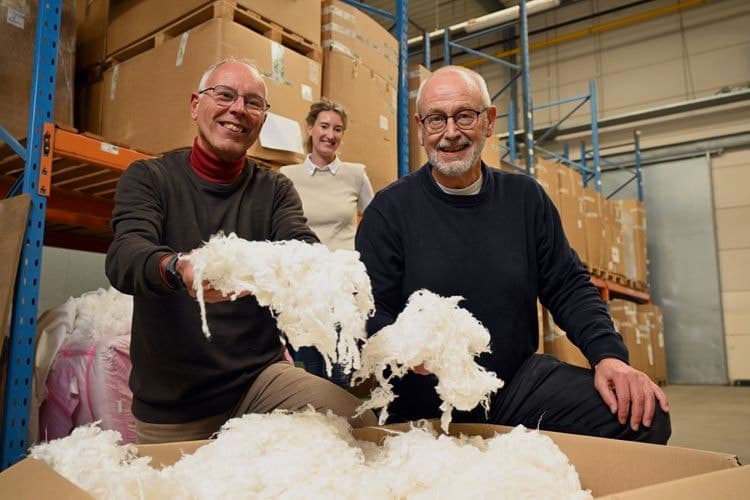
SaXcell begins with old cotton clothing, not a tree. Collected textiles are sorted into a clean cotton stream, ground down, and stripped of zippers, buttons, and other hardware, then chemically decolored to remove the dye of their past life.
That recycled pulp is built as a drop-in for the lyocell process: dissolved in a non-toxic solvent, spun into filament, then washed and dried, with the solvent and water recovered in a closed loop. The finished fiber is stronger than cotton and takes color deeply. It uses roughly 10 liters of water per kilogram, against 2,000 or more to grow the same weight of cotton.
This is early-stage technology, so read the label closely. SaXcell ran a pilot plant in 2020 and is building small-scale production in Enschede. Its commercial fiber, SaXcell L30, is currently 30 percent recycled pulp blended with 70 percent wood pulp, made with Birla Cellulose. A fully recycled bolt at retail scale is not here yet.
Is saxcell safe to wear?
Spun the lyocell way, SaXcell feels like TENCEL on skin: smooth, absorbent, with no leftover carbon disulfide and no harsh solvent, since the lyocell chemistry captures and reuses it. It breathes and moves moisture well, so it sits comfortably on hot or easily irritated skin.
The catch is where the fiber came from. Recycled cotton can carry the dyes and finishes of its earlier life, so the decoloring step, plus whatever dyes and coatings go onto the new cloth, decide how low-leftover the finished piece is. The fiber chemistry is reassuring. The finishing still needs an OEKO-TEX check.
- Stronger than cotton The lyocell spinning gives SaXcell higher tensile strength than the cotton it started as, so it holds up to wear and washing.
- Smooth, low-irritation surface Spun the same gentle lyocell way as TENCEL, so it causes little of the rubbing coarser fibers do.
- Diverts real textile waste Made from post-consumer cotton instead of fresh wood, keeping usable fiber out of landfill.

SaXcell runs the same closed-loop lyocell chemistry as TENCEL, so its fiber earns the clean-fiber score of 88. Recycling old cotton instead of fresh wood doesn't change the hazard math on your skin, since that comes down to the process, not the raw material. See the full method.
Doing this check on every product page yourself is the tedious part. The Toxome Chrome extension reads the composition for you while you shop, so you see whether something is saxcell (and what else is in it) before you buy, not after it arrives.
How to care for saxcell
Shop SaXcell


SaXcell, answered
No. It's spun by the same non-toxic, closed-loop lyocell process as TENCEL, starting from recycled cotton instead of fresh wood. Almost none of that solvent stays in the finished fiber.
Not at retail scale yet. The commercial fiber, SaXcell L30, is about 30 percent recycled cotton pulp blended with 70 percent wood pulp. The technology can run on recycled cotton, but the fully recycled version is still scaling up.
The chemistry is the same lyocell method. The difference is the raw material: SaXcell starts from used cotton textiles, while TENCEL starts from fresh wood pulp.
On water, by a wide margin. SaXcell uses roughly 10 liters of water per kilogram of fiber, against 2,000 or more to grow the same weight of cotton, and it keeps old textiles out of landfill.
- SaXcell - Sustainable Lyocell Fibres from Textile Waste · SaXcell
- SaXcell: regenerated cellulose from domestic cotton waste · Circle Economy Foundation Knowledge Hub
The health score reflects wearer health only and mirrors the Toxome app. This guide is educational and is not medical advice.