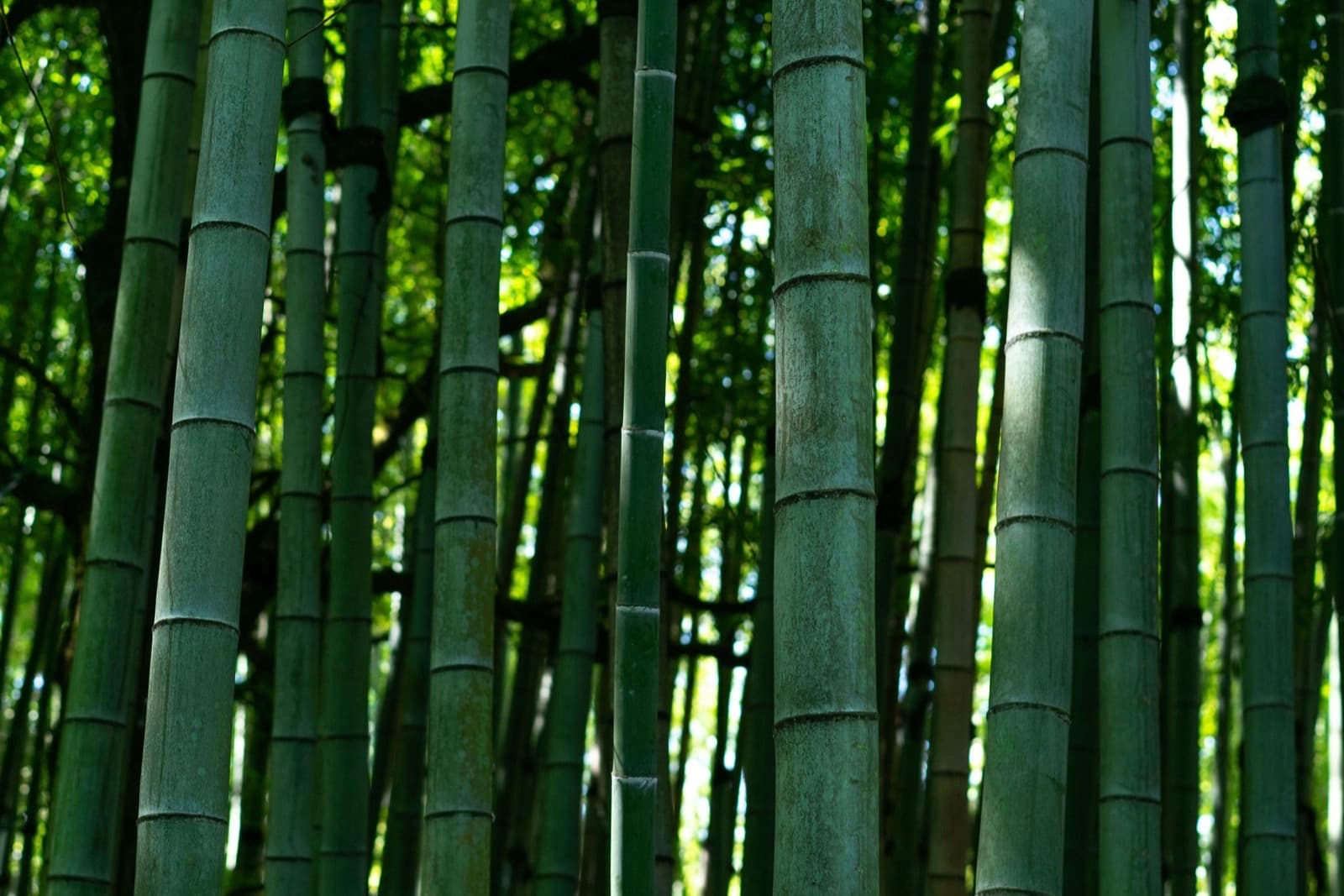
Bamboo scores 64 out of 100 for wearer health on Toxome's fiber scale, where 100 is cleanest. That puts it in the middle band. It is fine to wear, but you have to read the label. Bamboo is almost always generic viscose in disguise; the plant is clean, the processing isn't. The score rates the fiber, not the finished garment. Mills add dyes and finishes later, so check the label for those.
What is bamboo?
Soft bamboo clothing is almost never real bamboo fiber. It is bamboo viscose: bamboo mashed into pulp, dissolved in carbon disulfide, and turned into rayon. It is the same process and the same chemicals as ordinary viscose.
The word bamboo on soft fabric has a long enforcement record. In 2010 the US Federal Trade Commission sent warning letters to 78 retailers over rayon mislabeled as bamboo; in 2013 four of them, Sears, Amazon, Macy's, and Leon Max, paid $1.26 million in penalties. In 2022 the FTC went much further, fining Kohl's $2.5 million and Walmart $3 million, $5.5 million combined and the largest penalty it has ever levied in this area, for selling rayon as bamboo and calling it eco-friendly. US law requires the true fiber name on the tag: rayon made from bamboo or viscose from bamboo, never bamboo alone.
How bamboo is made
A fast-growing crop that needs no replanting and gets by on rainfall.
The woody stalk is chipped and mashed into pulp.
Dissolved in caustic soda and CS2, exactly like ordinary wood viscose.
Regenerated into thread. This is the step the plant's virtues do not survive.
Mechanically processed bamboo linen exists, but it is coarse, costly, and rare.
What reaches your skin from a bamboo label is, chemically, plain viscose.
The bamboo plant is a fast-growing, low-input crop. It does not need replanting after harvest and gets by on rainfall in most climates. None of that survives the trip from stalk to soft t-shirt. To turn woody bamboo into something wearable, the plant is chipped, mashed into pulp, and dissolved the same way ordinary wood pulp becomes viscose: in a bath of caustic soda and carbon disulfide, a solvent that is also an occupational hazard to the workers who handle it.
Once dissolved, the bamboo cellulose is forced through a spinneret and hardened back into thread in an acid bath, the identical regeneration step used for tree-pulp viscose. A different, mechanically processed bamboo fiber does exist, sometimes called bamboo linen, made by crushing the stalk and combing out the fiber with no chemical bath, the way flax becomes linen. It is coarser, more expensive, and rare, and it is almost never what you find on a soft, drapey bamboo t-shirt or sheet set.
The fiber that reaches your skin from a bamboo label is, chemically, plain viscose. The plant's fast growth and low water use do not carry through being dissolved into rayon, and the same finishing risk as any other viscose remains: leftover processing residue, dyes, and wrinkle-resistant treatments.
Not all bamboo is the same
There are two kinds of bamboo fabric, and the difference matters more than any eco claim on the tag. The version on almost every shelf is bamboo viscose or rayon, chemically dissolved and indistinguishable from tree-pulp viscose. A closed-loop bamboo lyocell uses a captured, non-toxic solvent and scores much higher. A true, mechanically processed bamboo fiber, sometimes sold as bamboo linen, skips the chemical bath entirely but is coarse, costly, and rare.
Is bamboo safe to wear?
Once you know that bamboo fabric is viscose, the health story is identical to viscose's. The plant's appealing qualities, fast growth and low water and pesticide use, do not transfer to the finished fiber, because dissolving it into rayon erases the plant's original structure. Factory workers who process it carry the documented occupational hazard, nerve and heart damage from carbon disulfide exposure. You do not.
For your skin, the risk is the same as any uncertified viscose: leftover processing chemicals, dyes, and formaldehyde-based wrinkle-resistant finishes that were not fully rinsed out. A bamboo claim tends to travel with fewer certifications, not more, because it leans on the plant's reputation instead of the finished garment's testing. Treat a bamboo label with the caution you would give a generic, uncertified rayon.
- Breathes like a plant fiber As dissolved cellulose, bamboo viscose lets air through and absorbs moisture rather than trapping it against skin the way a plastic fiber does.
- Soft, silk-like hand The regeneration process gives it a smooth, rounded fiber structure, which is why it feels soft and drapes well, not because it started as bamboo.
Bamboo fabric scores exactly like viscose, 64, in the wear with care band, because it is viscose: the same open-loop, carbon-disulfide process applied to bamboo pulp instead of tree pulp. Chasing the word bamboo buys you nothing extra. Chasing an OEKO-TEX Standard 100 label or a named closed-loop process does. See the full method.
Doing this check on every product page yourself is the tedious part. The Toxome Chrome extension reads the composition for you while you shop, so you see whether something is bamboo (and what else is in it) before you buy, not after it arrives.
How bamboo affects the planet
The important thing to understand is that soft "bamboo" fabric is bamboo viscose, so its environmental numbers are viscose's numbers, not the raw plant's. The living bamboo grows fast on little water, but that advantage is spent in the chemical processing.
A 2025 life-cycle study found that the processing, not the bamboo plant, is what drives the footprint. Bamboo viscose is not cleaner than wood viscose.
Bamboo fabric is bamboo *viscose*, so its numbers are viscose's, not the raw plant's.
A 2025 study found the *processing*, not the bamboo plant, drives the footprint.
Cellulose-based, same as wood viscose.
Cellulosic, not plastic.
Environmental figures are separate from the health score above, which reflects wearer health only. Numbers are per kilogram of finished fiber and rounded; see sources.
The bamboo label problem
Because bamboo fabric is viscose, it carries the same carbon disulfide worker harm as any other viscose. It is the same process and the same solvent.
The FTC has repeatedly fined major retailers for selling rayon as "bamboo," because bamboo's eco reputation does not survive the chemical process. By law it must be labeled rayon or viscose.
How to care for bamboo
Shop TENCEL lyocell & organic cotton Instead


Bamboo, answered
The plant is natural. The fabric almost never is in the way people mean it. Turning bamboo stalk into a soft t-shirt or sheet requires dissolving it in carbon disulfide, the same industrial process used for ordinary wood-pulp viscose. By US law the tag must say rayon or viscose made from bamboo, not bamboo alone.
Not in a way that poisons the wearer. The documented hazard, carbon disulfide exposure, falls on factory workers during manufacturing. Your risk as the wearer is the same as with any viscose: leftover residue, dyes, or a formaldehyde-based finish that was not fully rinsed out, more likely on a cheap, uncertified piece.
Not once it has been dissolved into rayon. Raw bamboo does carry some natural antimicrobial compounds, but the chemical process that turns it into soft fabric destroys that structure. The FTC has fined retailers for making this antibacterial claim on bamboo viscose.
By Toxome's scoring, no. Bamboo fabric scores like generic rayon, 64, in the wear-with-care band, while even conventional cotton scores 84, in the safest band. Organic cotton or a closed-loop bamboo lyocell would both outscore a standard bamboo viscose piece.
- Bamboo Textiles · U.S. Federal Trade Commission
- FTC doles out $1.3M in fines to retailers over bamboo rayon · Retail Dive
- TENCEL Lyocell and Modal Fibers · Lenzing TENCEL
- FTC Seeks Largest-Ever Civil Penalty for Bogus Bamboo Marketing · U.S. Federal Trade Commission
- Dirty Fashion: viscose supply chain pollution · Changing Markets Foundation
The health score reflects wearer health only and mirrors the Toxome app. This guide is educational and is not medical advice.