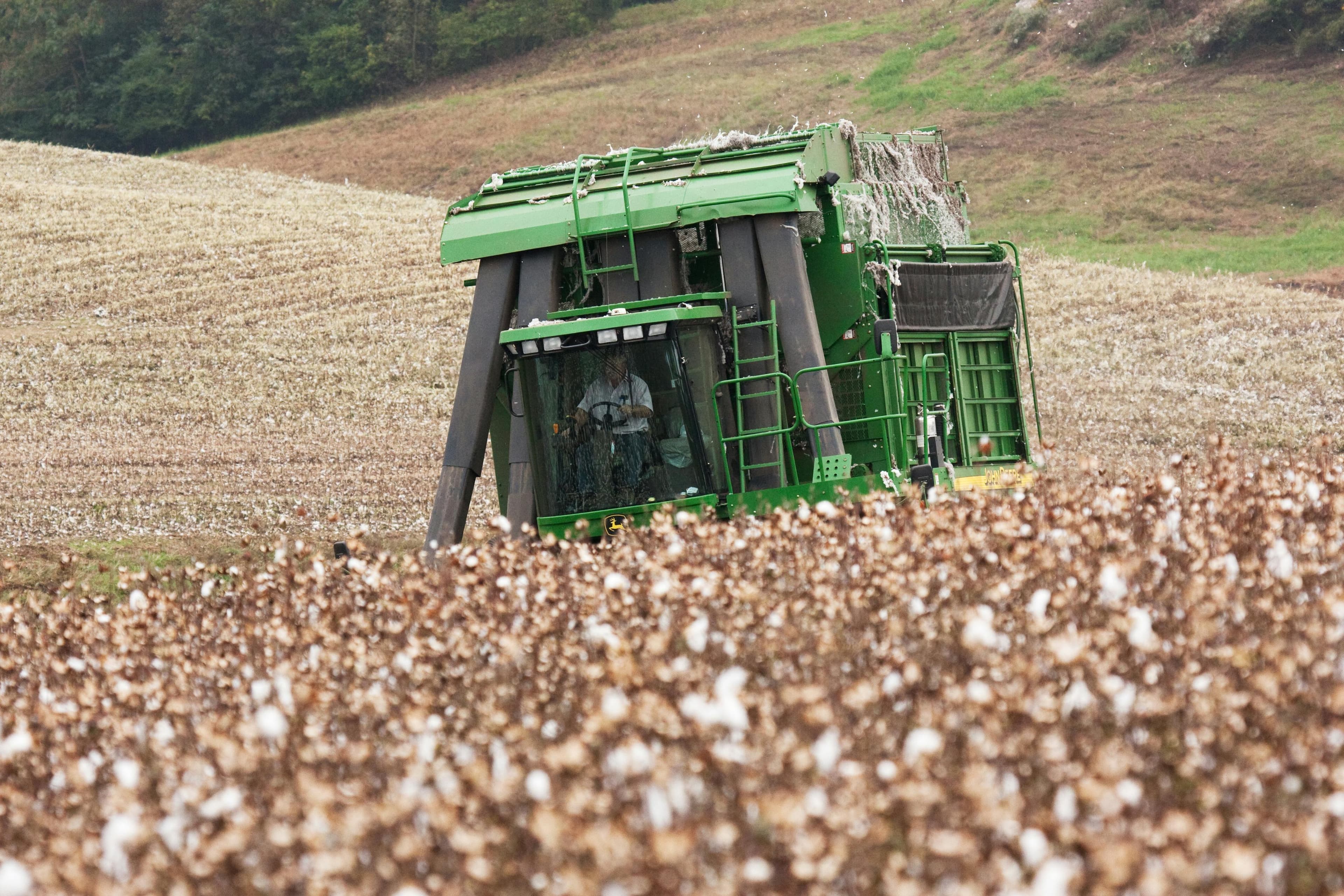
On May 28, the U.S. Department of Agriculture launched a program called the Great American Cotton Plan. Most of it is aimed at farmers. One part is aimed at your closet. The plan asks Americans to choose clothing made with natural cotton over, in the government's words, "petroleum-based synthetics like polyester."
Agriculture Secretary Brooke Rollins framed it as both an economic and a health move. She said American cotton growers had been "crushed by rising costs, unfair foreign competition and a flood of cheap synthetic products," and set a goal of making cotton "the fiber of choice" again. The Department of Health and Human Services joined the effort and linked it to the "Make America Healthy Again" agenda. "Supporting natural fibers like cotton," Rollins said, "also aligns with the Make America Healthy Again agenda as Americans grow increasingly concerned about microplastics and synthetic materials in everyday products."
The backdrop is a hard stretch for cotton farmers. The USDA forecasts that cotton producers could lose about $2.6 billion across 9 million planted acres in the coming crop year. The plan lists four goals: promote domestic cotton use, make cotton more affordable, improve cotton trade, and protect growers from risk.
The trouble has been building for years. In 2023, the United States lost its place as the world's top cotton exporter to Brazil, and growers are now facing what the industry describes as a fifth straight year of negative returns, squeezed between the high cost of planting and the low price they get at sale. The plan answers mostly with money for farmers: a higher reference price that triggers federal support payments, a larger subsidy for U.S. textile mills that buy domestic cotton, better terms on the loans growers use to get a crop to market, and backing for a bipartisan bill, the Buying American Cotton Act, meant to move more American cotton through the supply chain. Those pieces are aimed at the field and the mill. The part most people will actually see is aimed at the store.
The message aimed at shoppers
The closet-facing piece is a campaign called "Plant Not Plastic," first launched by the National Cotton Council in 2025 and now elevated by the USDA. Its argument is about microplastics, the tiny plastic particles that synthetic fabric sheds as it is worn and washed. The campaign's launch materials state: "Microplastics have been detected in critical organs, including the brain, kidneys, lungs, and even the uterus." Marjory Walker of the National Cotton Council said the goal is to make the issue concrete: "When consumers realize that the tiny plastic fibers shedding from their clothes can end up in the food they eat, the water they drink, and even within their own organs, the issue becomes incredibly personal."
The campaign also puts numbers to the exposure. By its accounting, the average person inhales or swallows somewhere between 74,000 and 121,000 microplastic particles a year, and clothing is one of the everyday sources it names. Those figures come from the cotton industry's own materials, which is worth keeping in mind: they are the opening of a conversation, not an independent audit.
How much of clothing is actually plastic
On the basic facts about fiber, the numbers are not in dispute. According to Textile Exchange, which tracks what the world's clothing is made of, close to 70 percent of all fiber produced today is synthetic. Polyester alone is about 59 percent. Polyester is a plastic made from oil. When it is described as "petroleum-based," that is a literal description of how it is made.
Polyester took over for plain reasons. It is cheap, it dries fast, it resists wrinkles, and it made the low prices of fast fashion possible. That is why it now fills so much of the average closet, often blended into clothes that read as cotton at a glance. Awareness of the trade-off is rising, too: in a survey from Cotton Incorporated, the share of shoppers who had heard of microplastics climbed from 17 percent in 2017 to 41 percent in 2026.
What the science shows, and what it doesn't
Researchers have reported finding microplastics in human blood, lungs, the placenta, and brain tissue. The particles are small enough to settle deep in the lungs and, some research suggests, to cross into the bloodstream. Synthetic clothing is considered one of the larger sources, though not the only one. How much of what turns up in the body comes specifically from clothing, rather than from plastic packaging, bottles, or household dust, has not been pinned down.
What scientists have not established is that the microplastics shedding from a shirt cause disease. The particles get into the body, and exposure is rising. The health effects are still being studied, and researchers are working out which exposures matter and at what levels. The campaign's language reflects a concern, not a settled medical conclusion.
The criticism
Not everyone agrees the plan earns its health framing. Writing in Sourcing Journal, reporter Jasmin Malik Chua called the message "compelling, if oversimplified," pointing out that every fabric sheds fibers, natural ones included, and that the chemicals used to treat cloth can matter as much as the fiber itself. Rebecca Burgess of Fibershed, a group focused on natural-fiber farming, described the plan as "a starting point rather than a solution to a deep need." Tameka Peoples, founder of the cotton company Seed2Shirt, said the funding missed an opportunity. Money aimed at "converting more conventional cotton to more regenerative cotton with less harmful chemicals," she said, "would have strengthened a real, cleaner push."
There is also the matter of cotton itself. Conventional cotton is one of the most pesticide-intensive crops, and any fabric, natural or synthetic, can be finished with dyes and treatments that carry their own chemistry. Supporters say cotton is still a cleaner default for clothing worn against the skin. Critics say "natural" is not the same as "clean," and that the plan is, at heart, a campaign to sell American cotton.
Other objections are about what the plan leaves out. Sourcing Journal noted that it makes no mention of climate change, even though extreme weather is one of the biggest threats to the farmers it sets out to help, and that the administration had recently cancelled climate-focused agriculture funding. There is a trade dimension as well. Much of the plan works by shifting where clothing is sourced, which means its effects reach past American farms and into the global supply chains that stitch most of what hangs in U.S. closets.
Where it lands
Two things appear to be true at once. The cotton industry has a clear commercial interest in this message. And synthetic fabric does shed plastic that ends up in the environment and, increasingly, in the human body. Where the line falls between a useful public-health nudge and a well-timed marketing campaign is exactly what people are debating.
While that argument runs its course, the simplest answer is already in your hands. Pull the pieces that stay closest the longest, the shirt you sleep in, the leggings you never take off, the sheets you breathe against all night, and read what they're made of.


