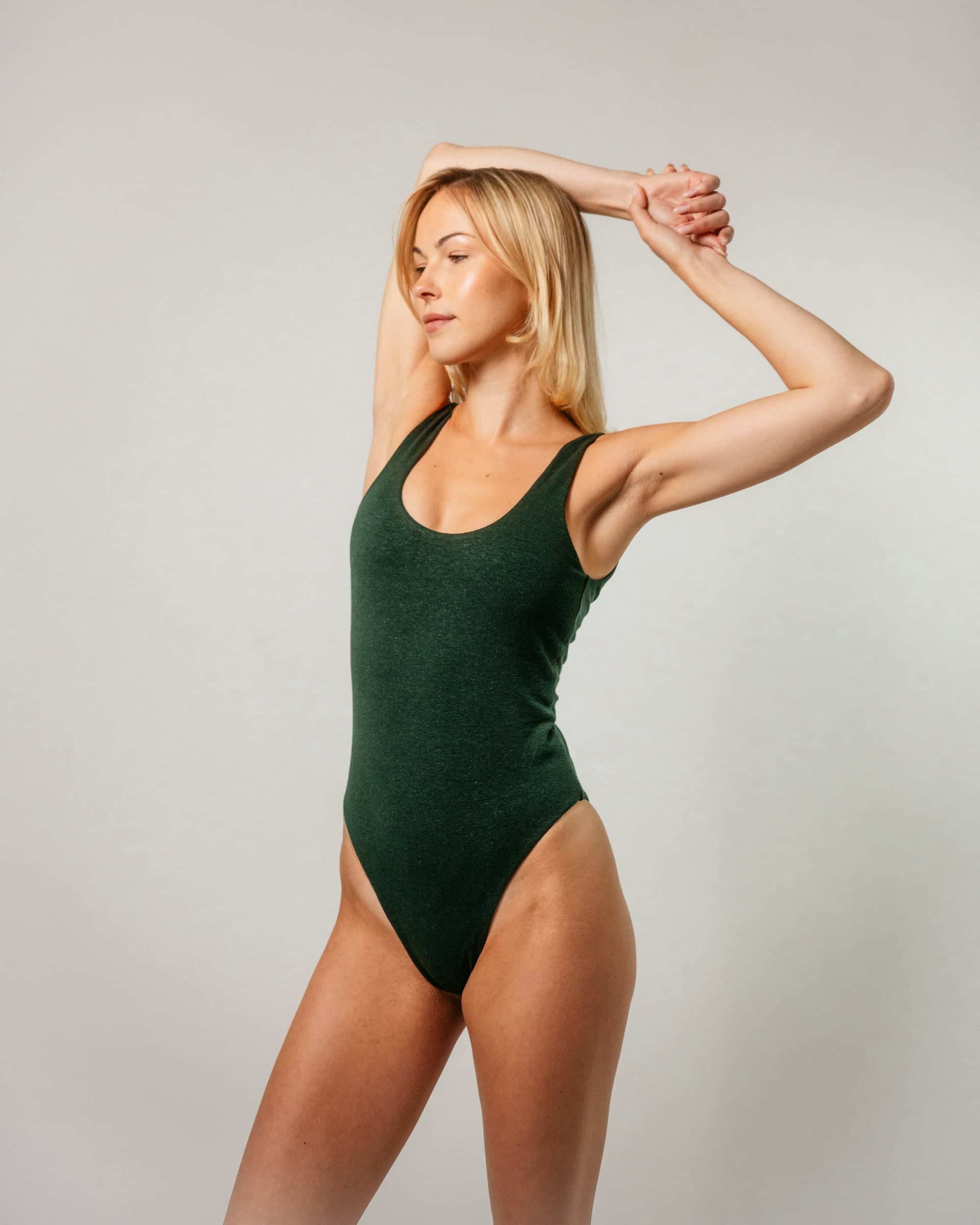
Your swimsuit is the most synthetic thing you own, and it earns the title. It has to stretch, recover when wet, hold a shape against a moving body, and dry before the drive home. Nylon and elastane do all of it cheaply, which is why the standard construction has not moved in fifty years: roughly eighty percent nylon, twenty percent elastane. Run that composition through a fiber score and it lands in the twenties. Recycled polyester, the version sold with a leaf on the tag, lands lower. Recycling the plastic changes where it came from and not what it does sitting wet against your skin in direct sun for six hours.
So what is the alternative made of? The answer is harder than it should be.
There is barely an alternative at all. Natural-fiber swimwear is about a half dozen brands worldwide, and several of the names that circulate in these lists are no longer real. One of the most-recommended labels publishes no fabric composition. Another redirects to a tortilla chip company. Several roundups fill the gap with organic cotton underwear and hope you don't click.
The brands that survive that filter fall into two camps. Hemp and organic cotton is the camp you already know about. Merino wool is the one almost nobody markets, and it is the more interesting half of the category. Wool crimps on its own, so it stretches and springs back with no elastane in the cloth. That makes it the only fiber that gets you a swimsuit with no plastic in it. Sustainability has nothing to do with it. This is a materials fact, and it has been sitting there the whole time.
Seven brands make the cut. One piece each, because a roundup that lists the same label four times is a catalogue, not an edit.
1. Organic One Piece Swimsuit
BeachCandy

53% organic hemp, 47% organic cotton · Made in Los Angeles · $169
The brand. Brit Arthur opened BeachCandy on Pacific Coast Highway in 2011 selling hand-beaded luxury swimwear, the kind that ends up on celebrities. Then she developed a spinal autoimmune disease, started asking what was in the things she wore every day, and rebuilt the label around organic fiber. It is still handmade in Los Angeles.
The highest-scoring suit here, and the reason is what is missing from it. No elastane at all. The stretch and the hold come from a silicone elastic, which is the structural trick the rest of the category never attempts. Hemp brings the strength and the antimicrobial behaviour, organic cotton brings the hand. One caution before you shop the wider range: the Olive colourway of their string styles carries 4% lycra where the Natural and Terra Cotta do not.
2. Clean Boardshorts
Industry of All Nations

100% organic cotton · Naturally dyed · Made in Tamil Nadu, India · $70
The brand. Three brothers run Industry of All Nations on one rule, which they state as clean clothes or no clothes. They manufacture at the source of the raw material instead of shipping fiber around the world, so the cotton in these was grown, spun, dyed and sewn in the same part of Tamil Nadu.
The rarest thing in menswear swim, because board shorts are polyester almost without exception. These are cotton through the whole garment and dyed with indigo rather than a petroleum colour, so both the fiber and the dye step out of the usual chemistry. They dry slower than a nylon short. That is the whole trade, and at seventy dollars you can afford to make it.
3. Merino Wool Triangle Bikini Top
Public Myth

100% merino wool · $98
The brand. A Vancouver activewear label that has been working in natural fiber since 2007, back when that was a commercial disadvantage rather than a marketing position. It makes its clothing at its own headquarters or, as it puts it, a few blocks away.
One fiber, no blend, no elastane. It reads like a misprint on a swim label and it is the most radical piece here. Wool crimps, so the fabric stretches and recovers on its own, and merino is fine enough that none of the scratch you are bracing for arrives. It resists odour without anyone spraying a finish on it to make that happen. Pearl white is the one to buy, and the matching tie bottom is another $98.
4. The One-Piece
Swim Good

53% organic hemp, 44% organic cotton, 3% elastane · $255

The brand. A young UK company that spent months developing a single cloth, a hemp and organic cotton blend, and then built a small range on top of it. It publishes less about itself than anyone here and more about its fabric, which in this category counts as a good sign.
The three percent of elastane is what separates this from the suits above it, and it buys a fit that behaves the way you expect a swimsuit to behave. It is also the only piece here carrying both GOTS and OEKO-TEX, which govern the dye house and not only the field. Moss is the cleanest cut in the range. The price is set in pounds, so what you pay in dollars moves with the rate.
5. Merino Wool Balconette Bikini Set
Zubek

98% merino wool, 2% elastane · 18.5 micron · Made in Krakow · $251
The brand. Sisters Aneta and Beata Zubek design in Zurich and make in Krakow, and they treat swimwear as one of four layers where skin meets fabric. Their merino is untreated and non-Superwash, which means it skips the plastic resin coating most washable-wool brands use to stop shrinkage.
A balconette cut, which is the shape merino almost never gets made in, held up by natural kauchuk rubber elastic rather than a synthetic band. The thread is cotton. It is the most considered construction in this piece, detail for detail. It is priced in euros with a real US storefront behind it, so the dollar figure is the one you pay.
6. Elke One Piece
Swimm

96% Australian merino wool, 4% elastane · Made in Melbourne · about $177 (A$247)
The brand. Chloe Peers started Swimm in Melbourne in 2018 on one question, which she puts on the tin: why swim in plastic when you can swim in wool. The wool comes from RWS-accredited, non-mulesed farms, the mill is Ethical Clothing Australia accredited, and the fabric is PFAS-free. Everything is made, packed and shipped from Melbourne.
A clean scoop one-piece in sepia, which is the muted end of a range that gets brighter fast. Four percent elastane is the cost of the four-way stretch, and this is the suit on the list most likely to behave like the nylon one you already own. Swimm charges in Australian dollars, so treat the US figure as an estimate that moves with the rate.
7. Merino One-Piece Swimsuit
Simply Merino

92% Australian merino wool, 8% elastane · 18.5 micron · Made in Vancouver · $125
The brand. A family operation in Vancouver, run by Shannon, Alex, Jack and Ruby, who design and sew everything in the city and buy Australian non-mulesed merino to do it. They recycle their fabric scraps and say the goal is to get to no waste at all.
The most elastane of anything here, and the lowest score because of it, which is exactly what the number is for. It is still a wool suit rather than a plastic one, it is Woolmark certified, and at 18.5 micron it stays soft. This is the merino entry point if the single-fiber pieces feel like too much commitment, and the cheapest wool suit on the list. Clay, moss and nutmeg over the brighter half of the range.
what to look for
Read the colourway, not the product. The most common trap in this category is a piece that is natural fiber in one shade and a lycra blend in another, on the same page, at the same price. Nobody is hiding it. The brand lists it once, in small type, under a colour swatch you have no reason to open.
Certifications govern the dye house, not just the field. GOTS and OEKO-TEX Standard 100 are the two worth knowing. GOTS follows an organic fiber through processing, including the dye, which is where much of the chemistry that touches you gets added. OEKO-TEX tests the finished product for harmful substances. Organic cotton with no certification behind it is a claim about a field and nothing else.
Recycled is not the same as natural. ECONYL, regenerated nylon and recycled polyester are better answers to a waste question and no answer at all to a fiber question. If the reason you are here is what sits against your skin, recycled plastic is still plastic.
A missing composition is the answer. Every brand in this piece states what its fabric is. The ones that did not make it mostly failed on that alone, and several of them are names you would recognise from other people's lists. Ask what a suit is made of before you ask anything else about it.
the short version
The category is tiny and the two routes through it are clear. Hemp and organic cotton, if you want the familiar hand and a suit that reads like a suit. Merino wool, if you want the only construction that gets to zero plastic, and you will hand wash it. BeachCandy is the cleanest thing on the list at 93, and the founder found her way there through her own diagnosis. Public Myth's single-fiber merino at 90 is the one nobody expects. Everything else on the rack this summer, including most of what is sold as sustainable, is nylon and elastane wearing a leaf.
Frequently asked
Yes, but barely. A handful of brands build suits from hemp and organic cotton or from merino wool, using silicone or natural rubber elastic instead of elastane. Everything else, including almost everything marketed as sustainable swimwear, is nylon, elastane, or polyester. The natural-fiber category is roughly a half dozen brands worldwide, and that is the honest size of it.
A swimsuit has to stretch, snap back when it is wet, hold its shape under a body in motion, and dry quickly. Nylon and elastane do all four cheaply and predictably. Natural fibers can do it, but they cost more, behave differently wet, and demand more of the pattern cutter. Very few brands take that on.
It is a better use of plastic that already exists, and that is worth something. It is not a different fiber. Recycled polyester and regenerated nylon sit against your skin exactly as virgin synthetics do and shed microfibers the same way in water. On fiber content they score no better, because the fiber is the same.
It does, and it is the part of this category almost nobody talks about. Wool fibers are naturally crimped, so they stretch and recover without any elastane in the fabric. Merino is fine enough to wear against skin without scratch, resists odour on its own, and dries faster than cotton. It is the only route to a swimsuit with no plastic in it at all.
Because the colour changes the fabric more often than anyone tells you. BeachCandy's string bikini is 55% hemp and 45% organic cotton in Natural and Terra Cotta, and the Olive colourway of the same piece is 53% hemp, 43% organic cotton and 4% lycra. Same product page, same price, different cloth. Click into the exact colour you are buying and read the composition again.
Read their labels before you trust the list. Several of the most-cited names publish no fabric composition, or state a partial one with no percentages. Others sell organic cotton underwear that roundups have filed as swim without checking. A brand that will not tell you what its fabric is has answered the question.


