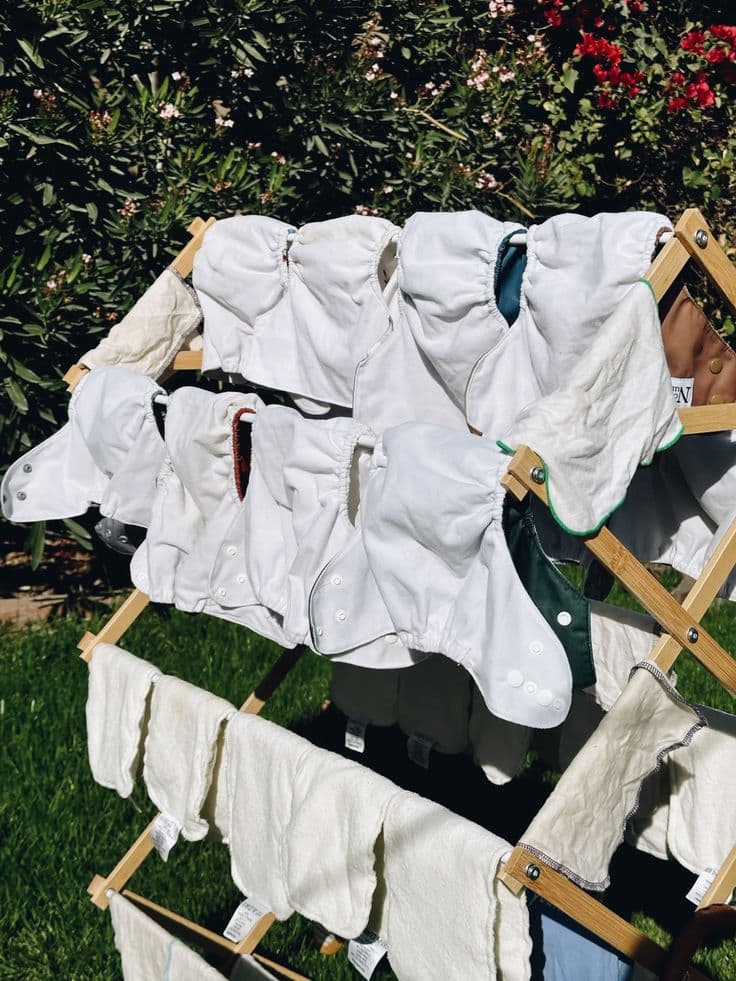
A baby wears a diaper for close to three years, day and night, against skin that is thinner and more permeable than an adult's. ANSES, the French health and safety agency, put the arithmetic at roughly 4,000 diapers between birth and age three when it tested disposables in 2019 and found health reference values exceeded for polycyclic aromatic hydrocarbons, dioxins and dioxin-like PCBs, plus formaldehyde and fragrances that had been added on purpose. Its recommendation was to eliminate or reduce those substances and to regulate the category properly.
Contact time is the variable most shoppers skip. A shirt goes on for twelve hours and comes off. A diaper stays on around the clock, on the one part of the body where skin sits occluded, warm and damp for the whole wear. No other garment gets those terms.
Cloth answers the question differently, because you can read the fiber on a label instead of trusting a proprietary core. The category has its own quiet substitution though, and it is easy to miss on a product page: nearly every pocket diaper and all-in-one is waterproofed with PUL, a polyester fabric with a polyurethane film bonded to it. A cover made of that scores 23, and it is also where the PFAS question sits. Independent lab screening has turned up organic fluorine, the marker for forever chemicals, in a share of the waterproof covers tested, because a fluorinated finish is one of the ways a laminate is made to shed water. The cleanest systems separate the two jobs, putting natural fiber against the baby and either wool or a swappable cover on the part that holds moisture in.
A cloth diaper is two purchases rather than one: the absorbent part that holds the mess, and the cover that keeps it in. The list below covers both, ordered by score, starting at $11.95:
1. Cloth-eez Workhorse Fitted Diaper
Green Mountain Diapers

100% organic unbleached cotton · Made in Pakistan · $11.95
The best value on this list and the one most people should start with. It is a shaped fitted with snaps and elastic, made from the same heavyweight woven cotton as the prefolds further down, so it holds a lot for its price. Green Mountain spells out what is and is not certified: the cotton is organic and grown in Turkey, the finished product carries OEKO-TEX Standard 100 under certificate 20, and full organic certification of the finished good is not claimed.
2. Growing Greens One-Size Fitted Cloth Diaper
Babee Greens

100% organic cotton fleece · Handmade in Asheville, NC · $22
The most thoroughly domestic diaper here. The cotton is grown and milled in the USA and the diaper is sewn in Asheville with unbleached cotton thread and latex-free elastic, which is a level of detail few brands bother to publish. It fits 5 to 35 pounds with a snap-in contour that doubles as a newborn diaper. A 55 percent hemp version is offered at $40 for heavier wetters.
3. Inner Cloth Diaper, Snap
Esembly

100% organic cotton twill · $38.50 for three
The trimmest fitted on the list, which is the whole point of a twill weave rather than fleece or terry. Esembly built its system as two deliberate halves, an absorbent Inner and a separate waterproof Outer, and the Inner is the half worth buying on its own if the cover is going to be wool. There is also a tie version with no plastic snaps at all, which folds open and dries faster.
4. Duo Fitted Diaper
Thirsties

100% organic cotton interlock, exclusive of snaps and trim · Made in the USA · $23.50
The stretchiest of the fitteds, because interlock knit moves in a way woven cotton does not. That gives it the best seal at the legs, which is the mechanism behind a diaper that contains a blowout. Worth knowing that most of the Thirsties catalog is PUL, so the Duo Fitted is the natural fiber piece within a range built around synthetic covers.
5. Cloth-eez Prefold Diapers, Organic Natural Unbleached
Green Mountain Diapers

100% organic unbleached cotton twill · $36.95 per dozen
The cheapest route to a full stash, at roughly three dollars a diaper. Prefolds are a rectangle of layered twill that folds into a cover, which is the oldest version of the system and still the one that holds up longest through repeated washing. Heavyweight, unbleached, undyed, and OEKO-TEX Standard 100 tested. The raw cotton is organic while the finished product is not certified organic, which Green Mountain says plainly on the page.
6. Hemp Night Fitted Cloth Diaper
EcoAble
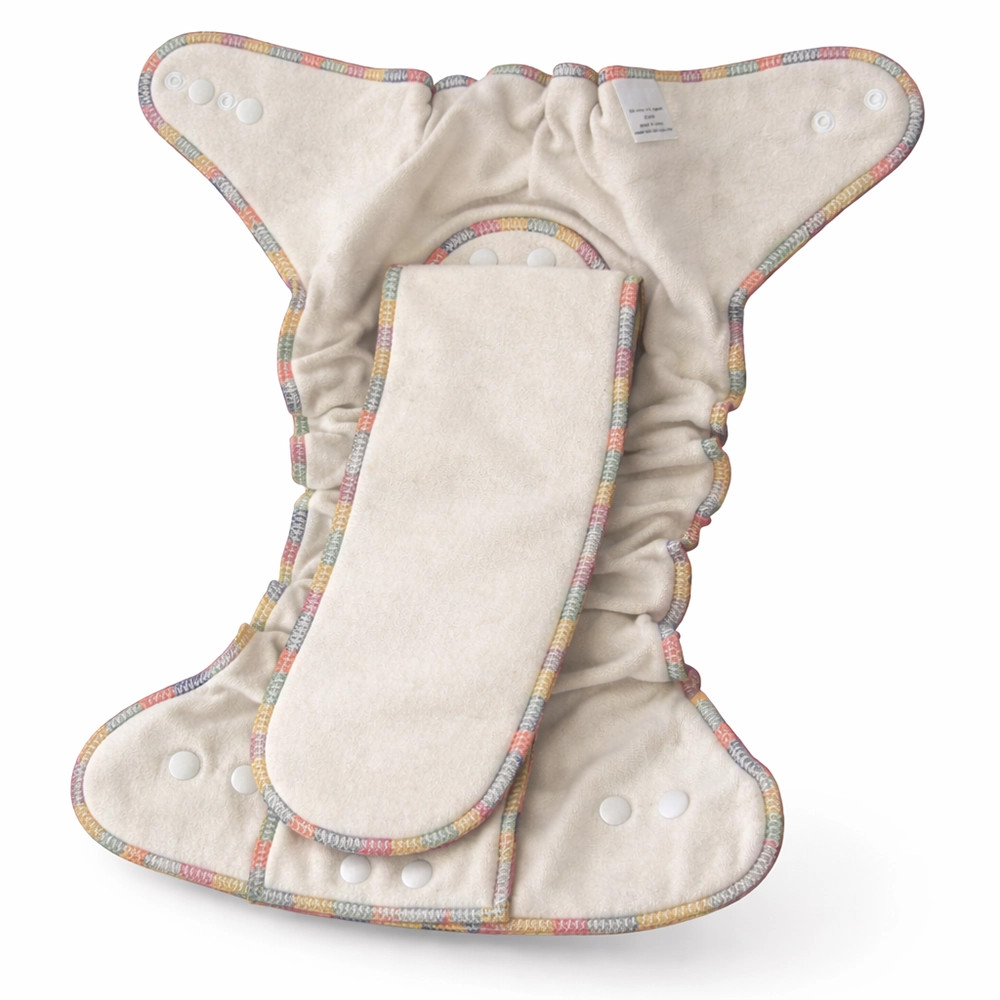
55% hemp, 45% cotton · $27.99
Built for the twelve-hour stretch, and the only overnight diaper here with no synthetic layer anywhere in it, inserts included. Most overnight solutions solve wetness with a polyester stay-dry liner against the skin, and this one solves it with hemp volume instead. The cotton is not listed as organic, which is the single thing separating its score from the fitteds above it.
7. Wool Pull-On Diaper Cover
Disana

100% merino wool from organic farming · Made in Germany · $42.95
The piece that makes a plastic-free system possible. A two-layer knit merino pull-on does the job PUL does, by absorbing rather than repelling, holding around 30 percent of its weight before it feels wet. You also wash it far less often than a synthetic cover, usually every few weeks, with a lanolin treatment to restore it. Different routine, and you get breathability for the trouble.
8. Classic Wool Diaper Cover
Babee Greens

100% merino wool interlock · Made in the USA · $39.95
The certified alternative to the Disana, and the trimmer of the two under clothes. Interlock knit gives it more stretch than a woven cover, so it sits closer without compressing the diaper underneath, which is what causes wicking at the leg. The wool carries OEKO-TEX Standard 100 and the cover is sewn in the USA from imported fabric.
The short version
Organic cotton for the diaper, hemp if you need it to last the night, wool for the cover. That combination is the only version of cloth diapering where nothing plastic touches the baby, and it costs more in laundry attention than in money.
One thing to check before buying: in this category the price shown is often for a single piece, a pack of three, or a dozen, and the three sit within a few dollars of each other on the page. Read the quantity before comparing. Then scan whatever is already in the drawer with the Toxome app, since the covers are usually where the synthetic is hiding.
Frequently asked
PUL stands for polyurethane laminate, and it is the waterproof layer in nearly every pocket diaper and all-in-one on the market. Technically most of it is now TPU, which is polyester fabric with a polyurethane film heat-bonded to it. It is plastic, and it is what makes a reusable diaper waterproof without wool. A typical polyester cover scores 23 on the same scale the picks here are scored on, which is the gap the wool covers in this list exist to close.
Some do, and it is the waterproof cover that carries the risk, not the absorbent cotton against the baby. In 2023 the environmental site Mamavation, working with Environmental Health News, had 65 reusable diapers and covers from 40 brands screened at an EPA-certified lab for organic fluorine, the marker chemists use to flag PFAS, and found it in about 23 percent of them, at 10 to 323 parts per million. The detections clustered in the polyurethane laminate covers, the same PUL and TPU layers that score 23 on the scale used here, because a fluorinated finish is one of the ways a laminate is made to shed water. A wool cover sidesteps the question, since it holds moisture through the fiber's own structure with nothing coated onto it.
The most thorough public assessment is the 2019 opinion from ANSES, the French health and safety agency, which tested disposables under realistic use and found health reference values exceeded for polycyclic aromatic hydrocarbons, dioxins and dioxin-like PCBs, along with formaldehyde and intentionally added fragrances including Lyral and Lilial. ANSES called for those substances to be eliminated or reduced and for a stricter regulatory framework. Cloth does not carry that particular question, because the material is a fiber you can read on a label.
With flats, prefolds and fitteds, yes, something has to hold the moisture in. The two options are a synthetic PUL cover or a wool one. Wool holds roughly 30 percent of its weight in liquid before it feels damp and is naturally odor resistant, which is why it needs washing every few weeks rather than every use. It costs more up front and asks for a lanolin wash a few times a season.
Usually not, because bamboo on a diaper label almost always means bamboo viscose. Mills dissolve the plant in a chemical process, and unless the brand names a closed-loop lyocell process that recovers its solvents, you are buying a regenerated cellulose fiber rather than the natural one the marketing implies. Hemp and organic cotton get you the same absorbency with none of that ambiguity, which is why neither appears on this list in bamboo.
A newborn goes through roughly 10 to 12 changes a day and a toddler around 6, so a full-time stash is usually 24 to 36 absorbent pieces plus 4 to 6 covers, sized for a wash every other day. Prefolds are the cheapest way to reach that number, at roughly three dollars a diaper against $22 or more for a shaped fitted.
Hemp holds more liquid per layer than cotton and releases odor less readily, so a hemp blend gets through a long stretch in fewer layers than cotton alone would need. That matters at night, when the alternative is either a synthetic stay-dry liner or a much bulkier diaper. Most hemp diaper fabric is a blend rather than pure hemp, typically around 55 to 60 percent hemp with cotton for softness.


